Categories
notes from JK

The £3m grant that would cost our council £5.4m

At the Conservative Party conference this autumn ministers announced a new gimmick: a council tax freeze grant. If councils agreed to keep council tax at the same rate as the previous year they would get a grant worth the equivalent of a 2.5% increase, for one year only.

On the face of it a clever way to show that Conservatives care about the squeezed middle classes in the face of increased inflation. Yet the harsh reality is this scheme doesn’t make financial sense for councils, and is yet another way the government are slashing budgets for local services. And in the long run it would likely lead to even greater council tax increases.

It’s absolutely clear to me that Greens were voted the largest party on Brighton & Hove City Council because of our commitment to public services and resisting the Tory agenda of “small government”. Residents expect us to use our Green values to fight for the fairest possible settlement in the face of unprecedented cuts from central government.

The tax freeze grant is another attack, a wolf in sheep’s clothing, which we oppose.

Why is it bad for the council? Because it would over 2 years cost us £5.4m, and more over the longer term. Let’s explore that in detail with an imaginary council called Picklesville with a £100 of income this year from council tax.

For the next year the councillors in Picklesville can either take the government’s grant worth a 2.5% increase or go with the Green option of a 3.5% increase.

If they take the government route they will receive £100 + £2.50 = £102.50 (£2.50 being the 2.5% grant from government).

If they go the Green route they will receive £100 + £3.50 = £103.50 (£3.50 being the 3.5% increase on council tax).

The next year the Picklesville councillors again need to decide on council tax. If they went for the government grant, that is now gone. So to catch up in the face of continued reductions in their formula grant (the other main source of income for councils other than charges) they decide to put council tax up by the maximum allowed, which is 3.5%. However because of last year’s freeze the starting point hasn’t moved. So they will receive £100 + £3.50 = £103.50 (£3.50 being the 3.5% increase on council tax over the previous year).

If they had gone the Green route then, still facing huge cuts in formula grant, they also decide to increase council tax by 3.5% so they receive £103.50 + £3.62 = £107.12 (£3.62 being the 3.5% increase on council tax over the previous year), quite a bit more than the other option.

These are of course hugely simplified numbers, but if you think in millions of pounds you can see that just freezing for one year (which every council already did for this financial year) leaves councils way behind each year, even if they keep increasing council tax. For Brighton & Hove accepting the one year freeze grant would mean £5.4m less income over 2 years. As we need to find savings of about £35m for the next two financial years, that £5.4m is money we can ill afford to give up.

With inflation running at over 5% and councils not allowed to increase council tax beyond 3.5%, council income is falling further and further behind the increasing costs our service providers are experiencing, even if we do increase tax by as much as we’re allowed.

The difference for the average council tax paying household in the city will be 57p a week, but the council can collectively use all those extra pennies to great use in protecting services and jobs the Tories would rather we axed. I’ve challenged the local Tories to list the extra £5.4m of service cuts they would propose if we adopt the grant as they are advocating.

Brighton & Hove is not the kind of place where we want to give up on the elderly, marginalised or vulnerable – those most in need of help. We believe in civilisation, in public service and the greater good.

A £3m grant that loses us £5.4m is not a good deal, how could it be? Accepting it would be agreeing to more Tory cuts, and acquiescing to the cynical politics of the Coalition government. As a Green, I resist.

(For the next 6 days you can watch the BBC Politics Show’s take on this here from the 38 minute mark)

UPDATED 26/11/2011: Revised figures now show the lost income from taking the grant would be £5.4m (this post originally had the figure at £4m). I also have clarified the difference in cost to be 57p per household (previously I referred to tax payer which is imprecise as council tax applies to properties and not people).

Local Government Chronicle has also shot a hole through Tory rhetoric that “Greens are the only ones” taking this approach, their survey shows 20% of councils (2/3rd of which are Tory led) are likely to reject the freeze grant. Furthermore many who said they would take the grant admitted it would lead to higher tax in future years. Exactly as I have said all along…

UPDATE 5/12/11: This interesting piece shows that most of the freeze grant has been taken from local government pensions funds. Completely unethical especially given the government rhetoric about the funds being a ‘burden’ which need more contributions.

Categories
notes from JK

The great local government squeeze


The government is dramatically cutting funding for local councils. You may be aware of the headline figures but these don’t adequately reflect the depth of the devious ways in which this money is being clawed away from local services and kept by the Treasury in Whitehall.


For example over 4 years Brighton & Hove City Council’s Formula Grant from central government will be reduced by 33%. But that’s just the start of things, the public face of the reductions.


Now begin the cuts by hook or by crook: Because academies don’t have to use local authorities for services, councils will lose some funding there, but not in a way which actually reflects the number of academies in our area – it’s a flat cut across the whole country.


Next the government cancelled the trading element of the Carbon Reduction Commitment. This would have ensured that the scheme was overall cost neutral. Now it will be costing Brighton & Hove over £200k next year which is going straight to funding the Department for Energy & Climate Change’s budget savings targets.


Council Tax Benefit is next, where the government is cutting 10% off the funding and leaving councils to either make up the gap themselves (somehow) or decide how to deliver reduced benefits to our residents. The depth of harm this change will bring is shown by the finance directors of all councils in Sussex unusually having jointly written to the government expressing their concern.


There’s also the case of the “missing business rates income”. Law requires that local authorities are paid from a ring-fenced fund made up of all the business rates collected. Every penny collected from business rates should be re-distributed to local government. However after the spending review it became clear that the total amount paid to local authorities in England will be much less than the total amount of business rates collected. The missing amount is estimated to be £2.5 billion pocketed by the Treasury and Brighton & Hove’s share of this would be about £12.5 million.


In the future there’s more to come. The government are proposing to introduce reform of local government finance. At the moment all business rates go into the (supposedly ring-fenced) national pot which is then redistributed to councils through a formula. The proposals are that councils would get to keep their business rates with a few caveats:


  • Ministers have promised that the first year of the new system will not differ significantly to the last year under the formula. So there will be a system of tariffs and top-ups to try and balance council incomes in line with what they received the year before.


  • Councils will be able to only keep new business rates income if that growth exceeds inflation and a nationally set growth target for England. Failure to exceed that target will result in councils not just standing still, but actually losing funding. Yes, losing funding. Business rate income which doesn’t exceed the target plus inflation will be clawed back by the Treasury, on top of the £2.5bn they’ve already sliced from business rate funding for local government.


All councils will have choices about how to face these cuts – will they prioritise results or appearances? Will they take the tough longer term thinking or try to take short term quick fixes which will swell into bigger problems in a few years? Will they go for redundancies or reduced pay? It will be incredibly tough and councillors of all political stripes will have considerable soul searching to do before budget setting meetings.


But we must never forget that this is all being imposed on us by a cynical Conservative/Liberal Democrat government who continue to pump out misleading nonsense. Government claims of reserves groaning with spare cash, acres of spare land and wasteful spending keep emerging to be debunked. but only after the headlines have splashed. Councillors will be able to decide the nuance of the cuts, but the size and speed is all of the government’s making.


What is their agenda here? It certainly isn’t to empower local government when they cut our budgets at every turn and don’t even trust us to set business rates ourselves. I think quite simply the government are trying to push as much of the pain of their mad budget cuts onto local government. In this way they can deflect the blame for service cuts onto councillors rather themselves. Almost as criminal as the Coalition’s actions is the Local Government Association’s extraordinary passivity in most of this. Do councils need to form a new collective to properly voice their anger in this time of crisis?


The government are destroying local government by starving it of resources. People’s quality of life will visibly suffer from this, the vulnerable will be put at risk and public services will be a wan shadow of their former selves. Welcome to localism.


Categories
notes from JK

Letter to Eric Pickles asking for end of second home tax discounts

This week I wrote to the Local Government minister, Eric Pickles MP, requesting that councils be given the option to end council tax discounts for second homes. At the moment councils can choose the level of discount for second home owners, but only down to a minimum 10% discount. Even this 10% costs Brighton & Hove City Council £177k a year in lost revenue. I believe we certainly shouldn’t be encouraging second home ownership with tax discounts, particularly when so many struggle to find affordable main homes.

Ideally there should be complete local control over land taxation (which is effectively what council tax is) but failing that we should at least be given discretion over the discounts. Tories claim to believe in localism and that they are devolving power and autonomy down to councils. Yet they are imposing massive, unnecessary reductions on our budgets whilst failing to give us any meaningful new powers or freedoms in relation to how we generate income. Ending the nationally imposed 10% minimum discount would be a small step in the right direction.

You can read the formal press release and the full letter is copied below.


Cllr Jason Kitcat
Brighton & Hove City Council
Kings House, Grand Avenue
Hove BN3 2LS

The Rt Hon Eric Pickles MP
Secretary of State for Communities & Local Government
Department for Communities and Local Government
Eland House, Bressenden Place
London
SW1E 5DU

28th September 2011


Dear Mr Pickles


SECOND HOME COUNCIL TAX DISCOUNTS

I am writing to ask that you give councils the opportunity to opt out of providing second home council tax discounts if they so wish.

As you will know councils face challenging financial times due to your government’s imposed budget reductions, demographic pressures and inflation, particularly on energy costs. Furthermore given the desperate shortage of affordable homes, we believe some councils including Brighton & Hove City Council would, given the powers, opt to eliminate second home council tax discounts. This would signal our desire to discourage second homes being maintained, and rather that they should be available for people use as their main homes.

In Brighton & Hove it currently costs the council £177,000 in lost revenue each year to provide the second home discount (see below for breakdown of this figure). We believe these funds should be used to protect existing services rather than subsidise reduced costs for second-home owners.

I know you passionately believe in localism so ask that you give local authorities the discretion on whether to offer a second home discount on council tax.

I look forward to your response.

Sincerely,

Cllr Jason Kitcat

Cabinet Member for Finance & Central Services


Breakdown of lost revenue from second home council tax discounts in Brighton & Hove (2011/12)


  Band A B C D E F G H Total
number of discounts 191 228 269 213 198 68 49 7 1223
CT payable £988 £1,153 £1,318 £1,482 £1,812 £2,141 £2,471 £2,965  
10% x number of discounts £18,877 £26,289 £35,448 £31,577 £35,876 £14,561 £12,107 £2,075 £176,810


Categories
notes from JK

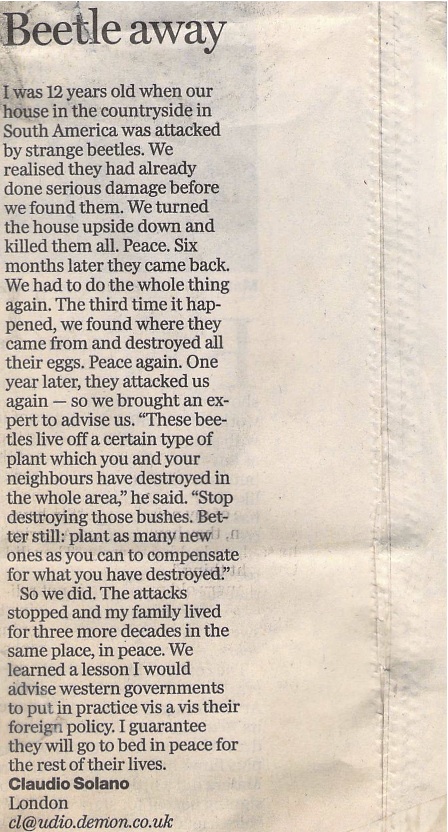
From the scrapbook: Beetles, bushes & foreign policy

An interesting letter I clipped from The Guardian many years ago. I couldn’t find it online so am not able to date it.

Categories
notes from JK

Subtle hint: Total Politics blog awards

Click here to vote in the Total Politics Blog Awards 2011

It’s time to vote in the Total Politics Blog awards. Go and tell them which political blogs you like here. You could vote for this humble blog whilst you’re there… or not!

Categories
notes from JK

Links 10-08-2011

Lots of good writing on the web at the moment, trying to get to grips with the turmoil in the world. Three good, different reads:

Categories
notes from JK

Letter in response to budget queries

I submitted this letter to The Argus in response to this spread of letters on the budget process. Unfortunately The Argus haven’t yet chosen to publish it, so here it is:

Sir,

How quick the Conservative and Labour councillors are to criticise, yet it is both their parties who argue the devastating budget cuts being imposed on us are necessary. Greens disagree and we are campaigning hard to change national policies which will harm the poorest and most vulnerable residents of our city. We face a 33% cut in the council’s formula grant over 4 years.

Conservatives are being disingenuous in claiming they had no plans for a 2.5% council tax increase. On 17th February 2011 the Conservative administration’s cabinet voted for a Medium Term Financial Strategy which included a 2.5% council tax increase for the next three financial years. Will Jan Young and Cllr Ann Norman withdraw their statements to the contrary?

Let’s be clear, the discussion currently underway is about the next council budget for the financial year 2012/13. It is highly misleading to suggest the underspend from the last financial year (2010/11), which in their dying days Conservatives had already programmed into the current year’s budget (2011/12), should have anything to do with the next year (2012/13)!

It will be up to all councillors to vote on what the next budget will be, including council tax. We understand the challenge everyone’s finances are facing: We are being careful with every penny. The proposed 3.5% increase is below inflation and will cost a Band D taxpayer 85p more a week compared with this year’s tax rate. Meanwhile the council needs to reduce its spend by up to 15% in the next two years.

Our whole budget approach will be to face that challenge in the most open, inclusive and sensitive way possible. I encourage all The Argus’ readers to participate in the consultation process when it starts later this year.

Sincerely,
Cllr Jason Kitcat
Green Cabinet member for Finance & Central Services
Brighton & Hove City Council

UPDATE: The Argus have now published the letter.

Categories
notes from JK

The truth is out there: Debating the council budget

The response from the opposition parties to our budget process proposals and associated press release has been… interesting.

Firstly the Conservatives have been denying they ever planned 2.5% increases in council tax. They’re now claiming they probably would have continued with a council tax freeze. This is not only financially improbable given the 33% cuts to Brighton & Hove City Council’s formula grant funding imposed by central government, but it isn’t true.

At a Cabinet Meeting on 17th February 2011 the Conservative administration approved a report which explicitly included plans for a 2.5% council tax increase from 2012/13 through to 2014/15. Noting this plan was part of recommendation 2 of the report they all voted for, details are online here. Will they retract their claims to the contrary?

Two other points the Conservatives are making also deserve clarification. They make much of the £2.5m underspend delivered in the year 2010/11. However this money isn’t just sitting in a slush fund waiting to be spent. Much of it was allocated by the Conservative administration in the 2011/12 budget before they lost power. What is left of it is there to deal with the risks involved in the huge changes and funding reductions we have to face in the current budget year. That historical, one-off, underspend has essentially no significant bearing on planning for next year’s budget to cover 2012/13.

Tories also are making noise about how much the council spends on funding Union representatives. Yet they were the ones who increased the funding (reasonably in my view) to support work on ‘Single Status’. This was a complex and fraught issue to resolve historical and current pay disparities between male and female employees doing similar roles. There are still a few matters to resolve in that area but any administration would need to have reviewed the union and HR provisions as this work wrapped up. What is notable is that the Green administration have chosen to be more open in spelling out those funding streams, whilst the Tories buried them in the whole HR budget pot.

Meanwhile Labour are banging a drum about how we have broken our supposed pledge to “resist all cuts” by even planning to deal with the imposed service reductions. We are strongly challenging government’s policies and we are the only party locally to be opposing the consensus that the cuts are necessary. However we recognise that central government can force certain things on us, so we did not pledge to “resist all cuts” – I’ve checked every Green leaflet I have a copy of, as well as our web site – as far as I can see we never said “resist all cuts”. Will Labour, specifically Cllr Gill Mitchell who keeps repeating the line “resist all cuts”, either show us the Green leaflet they are quoting or retract their statements?

What Greens did say was that we would “resist, to the greatest extent possible, the service cuts and privatisation imposed [on us]”. And we will…

UPDATE: Labour are also claiming we pledged to “stop the cuts” in a Huffington Post blog, again we never pledged that. I have checked all our publications and our website, the only time that term arises is in relation to the “Stop the Cuts coalition” who we worked with and our attending a “Stop the Cuts” march. Our manifesto is online Labour, so pick something that was actually in it to bash us with!

Categories
notes from JK

The Case for Working with Your Hands

“We in the West have arranged our institutions to prevent the concentration of political power, with such devices as the separation of legislative, executive, and judicial functions. But we have failed utterly to prevent the concentration of economic power, or take account of how such concentration damages the conditions under which full human flourishing becomes possible (it is never guaranteed).”


That is Matthew Crawford’s concise, and devastatingly accurate conclusion. There’s more in his final chapter, but these few lines are the inevitable climax of his warm and cleverly argued book “The Case for Working with Your Hands”, published in the USA as “Shop Class As Soulcraft”.

Crawford’s book ranges from childhood memories, motorcycle repair to philosophy. In retelling his own unconventional career, Crawford examines what Taylorism and now the ‘knowledge economy’ have done to working people.

He draws interesting comparisons between managers lost in a world of unmeasurable, soft tasks and tradesmen who can clearly see when their work is ‘good’ and when repairs actually fix something. Out of necessity generalisations must be used, but certainly there is some large kernels of truth in Crawford’s reflections.

When someone feels in command of their trade, there is an inherent satisfaction in their work being completed: The motorbike is fixed, the lights are working in the room that has been wired. Or, as I saw in Berlin last week where bartenders took great pride in their work, the drink has been served correctly.

Throughout my working life I have felt a deep sense of unease about corporate life. From my earliest work experience in the banks of the City of London there has been a sense that office work could be somehow dehumanising. This is not to point the finger at any specific employer, or colleagues, because most were undoubtedly kind. But there is a systemic issue in how the layers of corporate power affect the average office worker. Matthew Crawford addresses much of this modern issue.

It’s notable to me that in Brighton & Hove City Council there’s a different feel. Despite being a large organisation with thousands of staff, I think the common theme of public service motivates us all. So while Matthew Crawford’s arguments feel valid in general, a sense of mission can perhaps trump them.

Categories
notes from JK

Towards building the first Green city budget

Building a fair, balanced and progressive budget is one of my key responsibilities. The process for approving that budget has to be as open and inclusive as possible. That’s my personal preference, and also the best way to make decisions on the incredibly difficult choices ahead.

So at next week’s Cabinet meeting I’ll be presenting a report setting out our thinking on the budget process. In summary we’ll be seeking to invite cross-party involvement throughout the process, not just at the end; and we will be reaching out to citizens, unions and the third sector to feed into our thinking too.

We want to give council departments the space for longer term thinking and more sustainable changes than annual ‘salami slicing’ of budgets. So I’ve asked for them to present two year, rather than just annual, spending plans. I’d go for longer if I had greater certainty about what central government will do with our funding in future years.

The previous Conservative administration had budgeted on 2.5% annual council tax increases for the coming years. The Green administration are seeking to move that to 3.5% per annum. This is equivalent to 85p more per week for a band D property. At 3.5% the rate is below all the measures of inflation recorded by the Office for National Statistics.

Greens believe council tax is an unfair tax, but Government does not allow us to use fairer alternatives, such as land value tax. We do not take decisions to raise the tax rate lightly, and we are committed to spending the money raised carefully. That extra 1% will help us to protect key services from the cuts.

Meanwhile the council will be seeking spending savings of up to 15% over the coming two years, while also dealing with significant pressures from increased costs in a number of key services. Our principles in judging how to meet these challenges will be:

  • To prioritise services for the young, elderly and vulnerable
  • To promote efficient use of public money
  • To support partnership working with public, private and third sector organisations

I want to emphasise the importance of the public engaging in this process, as a first step to greater community involvement in budget setting as we begin to pilot more neighbourhood decision-making. I know it’s going to be hard, but I passionately want to see more citizens discussing and understanding the council’s budget.

We also will be seeking to publish carbon budgets of some form. It is early days but, as with our program of public involvement in budget-setting, we hope the carbon budgeting will improve significantly each year.

While we will inevitably disagree on some proposals, I hope all parties will work with us constructively to face the challenge ahead of us. The Coalition government have imposed on Brighton & Hove huge, unnecessary cuts to our funding. All councillors are united in their passion for this city and I hope we can collectively move from tribalism to constructive working to come up with the best possible outcomes.