Categories
current affairs

Rogue Kindle Survey is not a Political poll

The Argus play an important part in Brighton & Hove’s community and political life. I have it delivered every morning.

So it’s particularly disappointing that they’ve published the results of a survey in the guise of a proper political poll. What do I mean by that? Well respected political pollsters like ICM, MORI etc use agreed procedures set by the British Polling Council. They weight results using measures to make the result more representative and a better predictor of election results. They also put a huge amount of thought into the questions to improve the likelihood that the results are accurate predictors of electoral behaviour.

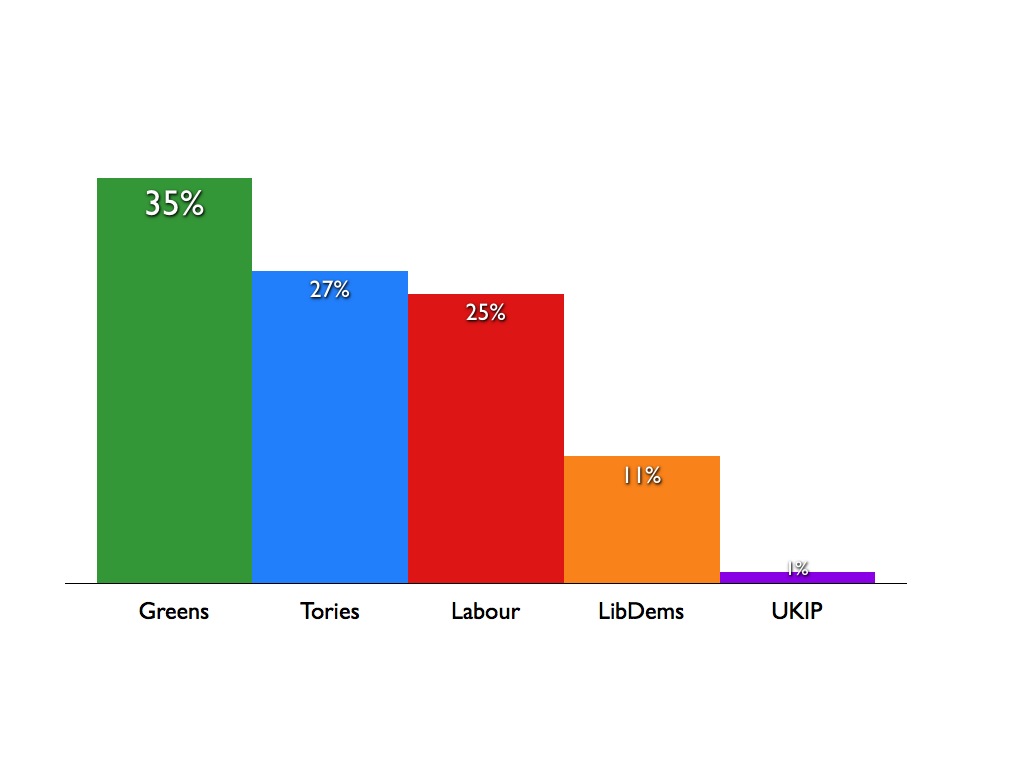
Of course polls make mistakes and there are elections where pollsters collectively get it wrong (e.g. Major’s surprise 1992 victory over Kinnock). But the results The Argus quotes are clearly way out of line. Greens scored 22% in Brighton Pavilion for the 2005 General Election, so a 12% Green vote-share is completely incongruous with Greens’ 31.4% in the 2009 Euros, 41.6% in the 2007 Regency by-election and 35% in the Dec 2009 ICM poll (see all the graphs). Furthermore, while I’m not keen to promote Tory chances, it’s absurd to suggest Labour are 10% ahead of the Tories in Brighton Pavilion in the face of a clear national Conservative poll lead of 6-10% and all recent local elections having Tories in a firm second place. This is a rogue survey, it doesn’t deserve to be given the status of poll.

For these figures The Argus cites a survey by Kindle Research, who look to be a small technology research consultancy, not political pollsters. From the information I’ve seen Kindle did ensure demographics were representative of the constituencies – they asked 336 people in each of the three Brighton & Hove parliamentary constituencies. This is a small sample size compared with 533 for the Dec 2009 ICM poll. They also didn’t prompt for ANY political parties. Political polls habitually prompt, because that’s what a ballot paper does when electors come to vote. Kindle also failed to filter out non-voters, which is a basic first step in political polling. I also understand that the political questions were tagged onto the end of a set of completely unrelated questions on a different topic. Kindle admit to having a 10% margin of error (compared to ICM’s 4.3%) but I think it’s even greater than that given not only the small sample size but the type of questioning without prompts or mention of the constituency.

In Brighton Pavilion Greens are fielding Caroline Lucas our high-profile leader, an MEP for 10 years and we have more than doubled our number of councillors in the city since 2005. The results The Argus cites just aren’t credible and do them a disservice.

The full Kindle Research results for Brighton Pavilion:

Labour 26%

Conservative 16%

Green 12%

LibDems 5%

UKIP 1%

Other 1%

Would not vote 11%

Undecided 19%

Refused 7%


Categories
notes from JK

Brighton Pavilion: A graphing battleground

Which graph do you think best describes the chances of parties in the fight for Brighton Pavilion constituency? The most recent election, poll or perhaps the last general election in the constituency? In their attempts to woo voters both Labour’s Nancy Platts and Conservative Charlotte Vere are making some interesting choices with their graphs.

Why do election graphs even matter? Because our perverse electoral system means you just need a majority of one vote to win the seat. Many people don’t want to see their votes get wasted by voting for third or fourth parties who don’t have a chance of winning. So we have tactical voting – people voting for the least worst winnable option in their opinion. As a result all the parties vie to show how good their chances of winning really are.

Personally I think you’re only as good as your last electoral test. Yes different voting systems and types of election will influence how people vote – for example, UKIP do vastly better in Euro than local elections. However, for the same place, each election does build a picture of the relative strengths of local parties.

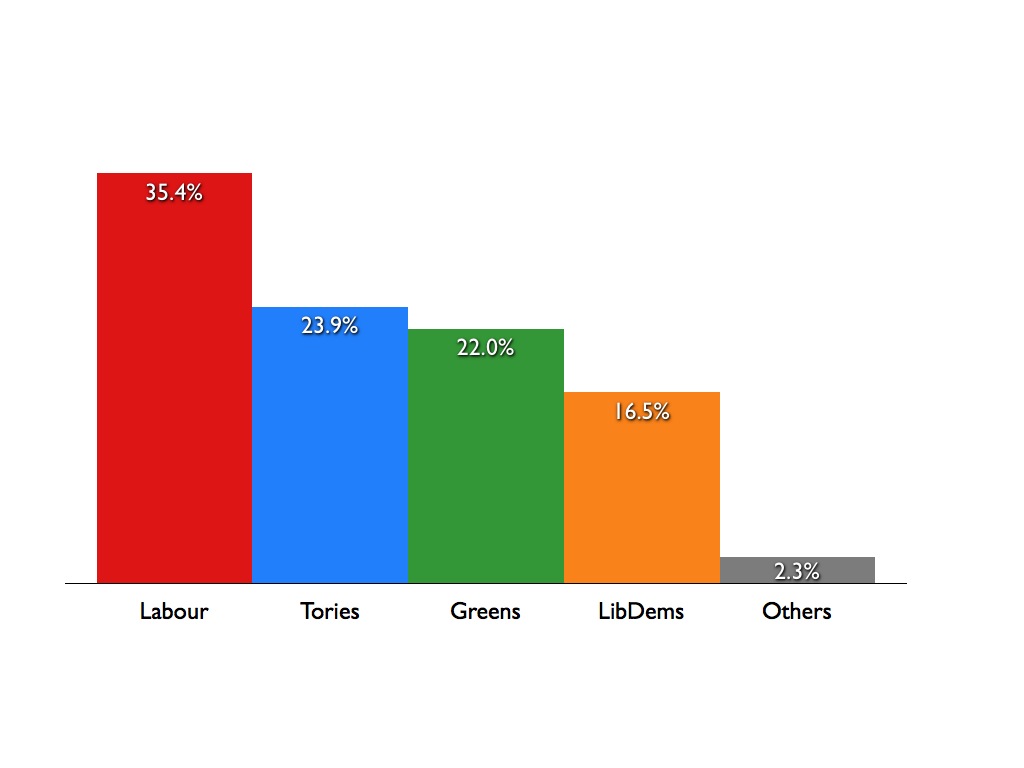
So let’s look at the tale of Brighton & Hove Green Party’s support in the Brighton Pavilion constituency. In 2005, when all the parties had different leaders (Blair, Howard, Kennedy and Greens yet to elect their first leader) and Brighton Pavilion had a different boundary, Keith Taylor brought home a record 22% of the vote for the Greens.

2005 General Election result, Brighton Pavilion

The May 2007 council elections saw us just beat the Tories into first place across the constituency. The December 2007 by-election in Regency ward (which elected me to the council) saw the gap between Greens and other parties widen dramatically. This was repeated in the 2009 Goldsmid by-election, but as it falls outside of Brighton Pavilion is not included here.

May 2007 Council Election results, Brighton Pavilion
December 2007, Regency council by-election result

Next we saw the June 2009 European Elections. Unfortunately we don’t have constituency-level results for these but city-wide Greens came top, beating all the parties for the first time, a feat we repeated in several other cities across the country.

June 2009 European Elections, Brighton & Hove city-wide result

Finally in December 2009 the Green Party commission an ICM poll which showed the same pattern once again – Greens in the lead followed by Tories then Labour.

December 2009 ICM Poll Result, Brighton Pavilion

Some have criticised the poll result – yes it was commissioned by the Green Party – but ICM are a member of the British Polling Council and so are bound by its standards. It’s not like they bucked the trend – the graphs above show results have been pointing in this direction for quite some time. Furthermore the new boundary for Brighton Pavilion includes all of Hanover & Elm Grove ward, which is represented by three Green councillors and has had a strong Green vote for a very long time indeed.

All this to say that the electoral statistics are not easy to address for Caroline Lucas‘ opponents. Still it’s interesting to observe how they handle the challenge. Labour’s Nancy Platts goes for ignoring 5 years of history and suggesting that a Green vote will let the Tories in.

Graph of 2005 General Election result in a 2010 Labour leaflet from Nancy Platts
2005 Election Results, from Nancy Platts' website

This is Nancy’s only option, the most recent graph which shows Labour ahead in the constituency. Sadly, if anything, thanks to our electoral system a Labour vote is likely to let the Tories in this time around. Labour have been trying the old ‘Green vote lets the Tories in’ trick for years in Brighton & Hove, I think people are pretty sick of being told something which evidently hasn’t been held out in recent elections.

(On a side note in writing this post I’ve noticed that different online sources cite the 2005 Green result as either 21.9% or 22.0% — it’s not just a rounding issue, the actual voter numbers differ e.g. BBC vs UK Polling Report. Not a massive difference but just wanted to flag up that I’m aware of it.)

Charlotte Vere treads a rather unusual path with her graphs. First this gem from her most recent leaflet:

2005 General Election result, from 2010 Charlotte Vere leaflet

My scanner may not be the best in the world, but the graph really is that jagged and blocky on the leaflet itself! Notice anything missing from the graph? Yes – Green and LibDem votes! In my view, it really is an extraordinarily misleading graph.

The same leaflet also includes a graph showing remarkable levels of support for the Conservatives:

Pulse GP poll, from 2010 Charlotte Vere leaflet

Pulse, a news rag for GPs, conducted a poll of some of their readers. I’m told by GP friends that the paper is heavily funded by pharmaceutical companies and isn’t considered much of a serious news-source. Regardless, given that most GPs are well into the top tax bracket it’s no surprise they support Tories. But unless there has been a rush of GPs moving to live into Brighton Pavilion, this poll is unrepresentative and bears no relation to what’s happening in the constituency. Is it there for any reason other than to mislead?

While we continue to suffer under our simplistic, winner-takes-all electoral system I’m afraid these kinds of graphing horrors are likely to continue. Whoever people finally cast their vote for, I hope they do so informed by facts and not the graphing skills of the local Labour or Tory activists.

UPDATE: Of course all this talk backed by GP polls from the Tories about being the party of the NHS is deeply misleading as they’re planning to break it up into further private ‘marketisation’ so when they say ‘NHS’ they mean something completely different to what most people understand – more info

Categories
current affairs

Preston Street: Ready for Regeneration

Preston Street needs help. Working with the traders association, chaired by Angelo Martinoli, we’ve tried petitions, meeting with cabinet members and their officers as well as press work in The Argus. Progress has been minimal I’m afraid, other than a few minor tweaks here and there and one vacant shop now with council-provided boarding.

This video highlights some of what the street is going through – I had to cut many other examples and comments from traders to keep it a reasonable length. The main three issues I hear again and again are:

  • The need for something like the i360 tower development to come forward to bring more people into the area;
  • Improved street-scape as the current setup is unattractive, riddled with double-parking and unworkable — ideally pedestrianisation or shared-space as on New Road is needed;
  • The recognition that many tourists drive to Brighton but parking fees discourage people staying in that part of town when other car parks elsewhere are cheaper.

As a Green, parking is a tricky one for me, but I don’t like waste and the council’s Regency Square car park currently stands mostly empty every day. Since this film was made the council have approved new 1 hour and fixed evening fees for Regency Square (before 2 hours was the minimum charge). These are yet to have been implemented and were brought forward without any consultation or discussion beyond the initial petitions I presented flagging up the poor use of the car park.

We’ll be sending this video to key decision-makers in the council. Please do support Preston Street and if you have any comments or ideas get in touch.

Categories
notes from JK

Speech: Responding to GP-led clinic scrutiny report

I presented this speech in response to a scrutiny panel report I contributed to being presented to full council 28th January 2010. Nobody answered my question at the end of the speech:

I would like to thank Cllr Denise Cobb who was chair of HOSC at the time for agreeing to create this panel after several months of questions on these matters by myself and other members.

I also thank the panel Chair Cllr Alford for his very even handed and co-operative working, as well as Cllr Allen, with whom it always a pleasure to serve with. My thanks to our officer Giles Rossington for his excellent support. I do commend this report to members.

This report is very timely given the continued pressure to further privatise parts of the NHS and package public services off to private businesses.

The panel’s concerns over the tender process favouring larger corporations should trigger alarm bells for all those worried about the future of the NHS. Similarly how such changes are consulted upon with the public was cause for concern with the panel and continue to be a public issue of importance.

These private contracts are riven with problems. The President of the British Orthopaedic Association recently wrote to The Times highlighting grave concerns over their quality control and service levels. A study of one private treatment centre found two third of operations showed poor technique and that after 3 years 18% needed revision operations compared to a 0.9% NHS-wide rate.

Cataract operations at a private treatment centre in Oxfordshire have cost up to 600% over the odds and performed only 93 of 572 contracted procedures for half a year. Meanwhile eye operations in a private contract treatment centre in Portsmouth have cost seven times more than they would on the NHS.

Health service experts the King’s Fund argue these contracts are a drain on Primary Care Trust finances. At a 2008 HOSC meeting a clinician from Brighton & Sussex University Hospitals Trust admitted that the private orthopaedic procedures alone were costing them £2-3 million a year.

The chosen contractor for Brighton’s clinic, Care UK, do have serious ongoing questions over their ability to provide consistent high quality care in our area as well as the rest of the country. In spite… or perhaps because of this… their annual healthcare profit has been in double digit growth for years, including 44% growth in profit for 2009.

Clearly the Conservative Party want more of this kind of privatisation when their 2010 health manifesto states that they aim:

“To give patients even more choice, we will open up the NHS to include new independent and voluntary sector providers…”

We recently learnt that the chairman of Care UK and his wife are giving tens of thousands to fund the Conservative shadow health secretary Andrew Lansley’s office.

So, the question I must ask the Conservative group is…. Is this the kind of privatising corporate ‘greed is good’ politics we can expect if David Cameron wins the general election?

Categories
notes from JK

Speech: A High Pay Commission

I copy below the speech I presented in support of this motion for a High Pay Commission, which was carried but only with a Labour wrecking motion (supported by the Conservatives) at full council 28th January 2010:

The top allowance for a councillor in this chamber is only 3.4 times more than the lowest councillor allowance. In terms of allowances, we are a fairly equally rewarded bunch, unlike much of society.

According to Compass, the average ratio of chief-executive to employee pay is 128 times, and several sources agree this has at least doubled in the last decade. In some FTSE 100 firms the pay ratio is now over 1,000 times.

Why limit high pay? Because it’s unfair, it doesn’t create better results and the gap between top and bottom pay is getting worse.

This motion really calls for what is fair pay for all. Shareholders and boards of directors have dramatically failed to reign in the widening pay gap. On pay, both private companies and public services have had long enough to get their house in order.

Some have dealt with the pay gap: A fixed ratio of top and bottom rates of pay is used by successful firms including Toyota, Whole Earth Foods and the St Lukes advertising agency. They do this because there is a good business case for limiting the ratio between top and bottom levels of pay.

Think of companies who have let our country down recently… the banks for example.

20 years ago the pay difference between a bank Chief Exec and next level down was only 2-3 times. Now the ratio between chief and deputy is 20-30 times, imagine what it is between Chief Exec and the lowest paid bank employee. Can we say we’re happy with how banks have conducted themselves? They’re now a national disgrace.

Such pay gaps lead to greater unfairness in our society. We know unfair differences in family income are a key factor that contributes to many societal problems.

The idea of a High Pay Commission to limit top pay is backed by the best business research. For example, Jim Collins for his bestselling book “Good to Great” conducted 112 analyses on pay ratios alone. He found that:

“…the idea that the structure of executive compensation is a key driver in corporate performance is simply not supported by the data.”

And he added:

“The right people will do the right things… regardless of the incentive system.”

Andy Law, from the St Lukes ad agency says:

“When you are exhorting people to co-operate with each other and to trust each other [at work], to impose an unequal system (as is most commonly done) is completely contradictory.”

If I haven’t convinced you so far, let’s try an example. Let’s think about this in a setting we can all relate to: the family. We were all children once…. In your family, how would you have felt if a brother, sister or cousin was awarded 128 more sweets than yourself for winning a game or doing a task particularly well?

You would be outraged with the unfairness and would feel dejected.

Such a huge gap in reward would not be motivating. Other than the one person gaining the disproportionately large reward, the rest would carry on demotivated. It isn’t fair.

Fairer pay is the hallmark of effective organisations, it’s good for business and good for society. The High Pay Commission we propose would be a step toward a more just, fair and balanced society – one in which all our families receive their fair reward for their hard work. Please support this motion.

Online Sources:

http://www.guardian.co.uk/business/2009/sep/16/guardian-executive-pay-survey-ratios

http://www.ft.com/cms/s/0/95d22e10-db89-11de-9424-00144feabdc0.html

http://www.nowandnext.com/?action=sector/view&issueId=25&sectorId=12

Categories
current affairs

My Green view on last night’s council meeting

Another long full council meeting last night. I tried tweeting between the parts I was most involved in and was pleased to see others following the meeting through Twitter. Sadly the webcasting is still quite unwieldy so perhaps Twitter is a good alternative for some.

I shall try to review the key parts of the meeting from my perspective. I won’t cover everything because, well the agenda was immense, and not all was within my remit or expertise.

Questions

As usual, I asked some questions of councillors. Unfortunately Cllr G Theobald refused to rule out shipping some of the city’s waste to landraise sites in East Sussex. I also continued my attempts to see the final city municipal waste strategy document before it gets rubber stamped. Cllr Theobald either doesn’t understand my point or chooses to ignore it by saying I will see it at the meeting which will approve the document – rather too late to be of any use in my view.

I also pressed Cllr Smith who had promised to engage directly with Brighton’s Sailing Club at the last full council meeting. They are very worried about the implications of the proposed Brighton O development. However since the last council meeting there have been no meetings. His responses to my questions were very unsatisfactory – claiming that a question from a sailing club member to Cllr Theobald at a public Cabinet Member Meeting was equivalent to dealing directly with the club. Neither I nor club members at last night’s meeting agreed with that view at all.

The main agenda

The council agenda had a number of very important and worthwhile reports from scrutiny panels. While implementation of their recommendations is mixed, I do think scrutiny panels are one of the highlights of how our current council constitution is working — unlike much of how the cabinet operates.

So it was a great pleasure to be able to speak to the report on Brighton’s privately contracted GP-led health clinic which I contributed to as a panel member and helped to initiate in the first place. I shall post my speech separately, but I chose to highlight ongoing concerns over such private contracts and as usual the other, privatising parties, were quick to moan about ‘politicising’ a panel report. It’s such a silly criticism, of course they’re political, full council is political and we’re all politicians — what do they expect!

Blocking fee increases for farmers markets & street traders

The next item I played an active part on was approving the licensing fees for 2010/11. For whatever reason the Conservative administration had decided to increase the annual fees for street traders and farmers market stalls by 10% – a big jump no matter what the economic situation. But recently the George Street farmers market has closed down and we know markets at Upper Gardner Street and elsewhere have struggled. Greens strongly felt that they should be supported and so submitted an amendment to freeze charges for street traders and farmers markets, removing the increases. They make up a very small part of the overall licensing regime so there were no major budgetary implications.

Then suddenly just before the meeting began the Tories produced an amendment reducing the fees from 10% to 1% claiming it was a drafting error to have put 10% in. I wasn’t convinced – if it was a genuine error it could be corrected in the Mayor’s communications at the start of the meeting, as indeed an error in another report was corrected yesterday. The fee report had 10% in the main body and the appendices. I think this 1% amendment – which was a Conservative group amendment, not an officer amendment – was some quick backtracking when they realised 10% wasn’t a particularly smart idea.

So after speeches, some of which entirely missed the point of the amendments, the meeting accepted our amendment and we had a Green win – farmers markets and street traders won’t see an increase in license fees this year!

12 month review of the constitution

Another item I have a great interest in is the progress on amending the council’s constitution. It was changed almost two years ago, against loud Green protests, and we’re in a continual process of reviewing and revising its workings. The recommendations from the 12 month review were all well and good, but quite timid. One amendment we proposed last night was to split the Environment & Community Safety Scrutiny committee into two. Its agenda and remit is so large, Environment being the largest department in the council by far, that it struggles to cover enough ground. We feel Community Safety deserves its own committee. However the other parties resisted for various reasons. We proposed to fund this by abolishing two of the little used Cabinet Member Meetings – which is where the members sit in a public meeting to declare decisions they have already made.

Cabinet member Cllr Ayas Fallon-Khan then chose to speak in one of his now trademark outbursts attacking all and sundry (well the Greens) for cutting some Cabinet Member Meetings in our amendment. What he failed to mention is that his own Cabinet Member Meetings were already being cut in the main Conservative report!

The Green amendment wasn’t supported but we will keep plugging away at trying to improve the council constitution.

High Pay Commission

The highlight of the evening, for me, was this motion which I was seconding with Cllr Bill Randall as the proposer. Bill very graciously (and without warning me) set me up as knowledgeable in these matters leaving the bulk of the speaking to me. My speech (which I will post separately) was well received, I hope.

Labour councillor Kevin Allen then treated us to one of his very humorous speeches which lacked much substance. However it did reveal that Labour are so worried about Green chances in Brighton Pavilion that they’ve asked campaign group Compass (who launched the campaign on a High Pay Commission) to block our candidate and party leader Caroline Lucas from taking part in any more Compass events before the general election!

Cllr Allen proposed an amendment which basically congratulated the Labour government for all their work on this issue (yet the gap between highest and lowest paid continues to grow) and removed all the substantive points from our motion.

Ok, well the Labour group do that to us quite often. However the Conservative group voted to support the Labour amendment. Which just goes to show how similar Tories and Labour are – both not that interested in narrowing the pay gap it would seem. This left the motion far from our initial intention so Greens abstained but it was still carried overall.

Other motions

There was good debate on other motions including Cllr Rufus commenting on Labour’s foreign policies in relation to a fairtrade motion, Cllrs Wakefield-Jarrett and Fryer responding to the bizarre and inconsiderate Tory motion on van dwellers and more from Cllr Rachel Fryer and Cllr Pete West on licensing.

I opened my council email today to find an outpouring of support for the Green motion on Sussex University job cuts. So that went down well with unanimous support in the chamber if I recall rightly.

My final memorable moment was on a Green motion about neighbourhood policing. Green Cllr Ben Duncan, the council’s only elected representative to Sussex Police Authority, is a bit of a target for the other parties at the moment. They can’t stand that he’s the only representative nor that Ben doesn’t universally praise the police or criticise protests. Throughout the meeting there had been digs at Ben. The Tories proposed an amendment to his motion to:

ask the Council’s solerepresentative on the Sussex Police Authority to relay to his fellow members the Council’s view that the proactive use of Anti-Social Behaviour Orders and a tough stance against benefit fraud has had a significant positive effect on reducing both “crime and, crucially, the fear of crime” in Brighton & Hove.

This was a direct attack on our view that ASBOs don’t work and criminalise people who need help. We’ve also been concerned about the public statements Conservative members have made around benefit fraud, though of course we don’t condone fraud in any way. Bizarrely Labour supported this amendment too. Leaving us once again unable to tell Tories and Labour apart.

It was a long night but with some good results for the city and a clutch of excellent scrutiny reports which offer plenty of recommendations for us all to be working on.
Categories
current affairs

What about the policies?

The last few months have been instructive as we’ve seen both local Tory and Labour activists engage in negative, personal attacks on the Green candidate for Brighton Pavilion, Caroline Lucas.

Sadly this is nothing new, I was subject to personal attacks when campaigning to win the Regency by-election in 2007. In both cases the salient fact is that the other parties don’t seem able or willing to engage with Greens on issues of policy – which is what I suspect voters would rather see us debating.

The personal attacks seem to come out when they recognise the Greens as a serious threat to their electoral cartel. Back in 2007 we were best placed to win, and we did — hence it will be my honour and duty to attend this afternoon’s full council meeting.

Again in 2010 Greens are tipped to be in a position to win Brighton Pavilion at the General Election. I know Caroline Lucas will serve my constituents with energy and passion, as she has done for 10 years as our MEP.

To win voters over we’ll stay focussed on issues, policies and good old fashioned hard work. We’ll ignore the attacks – they’re a sign of policy weakness in my view – but we’ll rebut any falsehoods with vigour.

Categories
notes from JK

Organic flour has more minerals

Continuing tonight’s health theme, I wanted to post about some interesting data I’ve come upon. I followed up some letters published in the Soil Association’s Living Earth magazine.

The letters continued the debate over the FSA’s controversial report claiming no significant health benefits from eating organic. I’m not a food scientist but the terms and methods of the FSA report seemed destined for a narrow result which could be easily misinterpreted by the media. Though the pretty categorical wording of the FSA’s release helped the media along:

“there are no important differences in the nutrition content, or any additional health benefits, of organic food when compared with conventionally produced food”

What’s odd is that we’ve known for a long time that the mineral content in conventionally farmed produce has been declining. We also know that minerals are vital for maintaining our health. For example this 1997 paper shows how only Phosphorous has escaped significant decline over the fifty years between 1930s and 1980s whilst water content in fruit has increased significantly.

With financial support from some Soil Association members Peter Symonds, a chemist, analysed a variety of flours for their mineral content. Wholemeal, organic UK-grown flours were found to have by far the highest mineral levels for Selenium and Zinc. I’ve copied below the full data and comments from the chemist.

How we grow our food is important not just for the environment around us (e.g. fertilisers polluting our rivers) but for our longterm health. Mineral deficiencies can have long term debilitating health consequences. Sadly the government agency supposed to be championing healthy food is not just ignoring this issue but actively creating the impression the problem isn’t there!

[Full Data]

SELENIUM AND ZINC IN ORGANIC AND CONVENTIONALLY GROWN FLOUR.
January 2010

Hans Lobstein of Brighton and Ian Bowyer of Chelwood Gate, East Sussex,  members of the Soil Association,  have funded an initial consumer survey of white and wholemeal flour for bread making which is sold in England. The  brands Stoneground organic and Marriages organic which were grown in the UK have the highest amount of selenium than conventionally grown.

BRAND AND TYPE                     ORGANIC                   SELENIUM                 ZINC

ug/100 grams        mg/100 grams

Marriages       strong  white               yes                         20.0                         —

Stoneground   strong  wholemeal       yes                         18.0                         —

Marriages       strong  wholemeal        yes                        17.6                         3.4

Marriges         strong  white                no                         15.6                         3.3

Allinsons         strong  wholemeal        no                         11.6                         2.8

Carr                strong  wholemeal        no                         10.2                         —

Dove               strong  wholemeal        yes                         4.2                          —

Hovis               strong  white               no                           3.6                          —

Hovis               strong  wholemeal        no                           3.2                          —

Tesco              soft      white                no                           2.2                         0.8

Morrisons        soft      wholemeal         no                           2.0                         2.6

Dove               soft      wholemeal        yes                          1.0                         2.7

Carr                strong  white                no                           1.0                          —

I have a sneaking suspicion that supermarket own brand Organic will be found to be like the Dove organic rather than the Marriages and Stoneground organic.  The Marriages wholemeal is £ 1.35 per 1.5 kilogram while the supermarket own brand is about £ 1.  I fear that people who think they can get organic at lower price in the supermarket are being short changed overall.

Peter Symonds  B.Sc. C.CHEM. M.R.S.C.

pmsymonds@yahoo.co.uk

http://sites.google.com/site/apexanalytical

[Earlier notes accompanying initial results]

1st December 2009

FOOD STANDARDS AGENCY REPORT COMPARING ORGANIC AND CONVENTIONALLY GROWN FOOD.

The Food Standards Agency has published a report that reviewed some published literature. The report concluded that organic food was not more nutritious than conventionally grown.  Hans Lobstein, a member of the Soil Association,  has funded an initial survey of wholemeal and white flour for breadmaking sold in England. The  brands Stoneground organic and Marriages organic which were grown in the UK have and higher amounts selenium and zinc than conventionally grown, see table.  The Dove flour is derived from wheat grown in Kazakhstan.

The full consumer survey would involve testing other premium brands such as Hovis and McDougal and supermarket own brand Organic flour.

The survey could be further extended to testing for all trace elements.  These can be measured reasonably cheaply using a modern analytical instrument, X Ray Fluorescence,  which measures all trace elements in one go.

A final effort would involve choosing 10 conventional farms and 10 organic farms (matched for wheat variety, soil and climate) and testing the wheat for selenium and trace elements.

300 grams of Stoneground flour per day provides about 56 ug of Selenium while other foods provide about 30 ug per day. Brazil nuts have approx 1560 ug per 100 grams so a few grams of nuts would bring the daily intake to the lower end of the recommended, 100 to 200 ug per day,  all without taking a supplement.  The figure for Brazil nuts has not been found from analysing nuts in health food shops but taken from The Composition of Food by McCance and Widdowson.  Of course,  Brazil is a big place and the composition of nuts may vary across the country.

Peter Symonds     pmsymonds@yahoo.co.uk

http://sites.google.com/site/apexanalytical

Categories
current affairs

Conservative health policy

I’ve been trying to find the time to post an analysis of the Tory draft health manifesto. But the more I’ve thought about it the less I’ve had to say. Not because it’s marvellous but because the essential points are so simple.

Much of the manifesto is contradictory – calling for less government control in some sections and more in others. Their thinking is muddled at best.

I find it astonishing that despite the NHS being clearly a huge Labour achievement the Conservatives several times over claim they are “the party of the NHS”. What an absurd thing to say. As a Green I feel no need to make such claims, just to offer policies that will improve our wellbeing such as more community-based healthcare and abolishing prescription charges.

The absolutely critical parts of this manifesto refer to that old political favourite of ‘choice’:

“We will give everyone the power to choose any healthcare provider that meets NHS standards.”

“To give patients even more choice, we will open up the NHS to include new independent and voluntary sector providers…”

There we have it. The NHS will be broken up and left to compete with other providers. Private providers I would suggest is where they are going. Because for Tories government provided options are ‘bad’ and in their free-market worldview competition is needed to boost the quality of government services.

We already know that marketisation, competition and privatisation in the NHS thus-far has been hugely expensive, resource intensive, problematic and with very mixed quality outcomes. (Read more: On this blog here and here, plus from the NHS Support Federation & Keep our NHS public)

I’m not entirely surprised by a Conservative push for further privatisation of the NHS, destroying public service and end-to-end treatments without changing providers n-times. But the revelation that the shadow health secretary Andew Lansley’s office is being bankrolled by the Chairman of Care UK makes things even clearer. Care UK are a leading private beneficiary of the NHS privatisation work Labour have done already. I’m sure Care UK can see very significant profits to reap from a Conservative-controlled NHS break-up.

I don’t believe that’s what the majority of British people want to happen, I just hope the manifesto’s weasel words will be exposed before people come to vote.

Categories
current affairs

Licensing & alcohol – we need action

While Police, Councillors and residents have been working together more effectively to block unnecessary new licensing applications, the problems of alcohol are continuing to weigh on our society.

The warnings are stark: The Royal College of Physicians and NHS Confederation are telling us that the costs of dealing with alcohol-related health problems could financially cripple the NHS. Meanwhile the Health Select Committee have slammed government’s failure to act on these problems whilst calling for minimum pricing per unit of alcohol.

The Committee also highlight what is an open secret in the licensed trade, that the Government has been in the pocket of the alcohol lobby. The 2003 Licensing Act was exactly the permissive piece of law that alcohol industry body The Portman Group wanted. The BBC report on the Health Committee’s findings includes strong criticism of the government by MPs, the British Medical Association, the British Liver Trust and Alcohol Concern.

I would say about 70-80% of my casework in the last few months has related to alcohol and licensed premises. The Licensing act is weak and we’re seeing locally a race to the bottom as one venue after another races to the latest opening hours (if they’re already licensed) or raced to become an off-license if not already licensed.

The local Licensing committee (on which I sit) also recently received a shocking report on the “Health Impact Assessment of Licensing” [PDF]. It highlights a sharp local increase in domestic violence whilst under the influence of alcohol and a very sharp increase in the level of alcohol-related hospital admissions — and this excludes A&E admissions.

Indeed it’s strangely inconsistent that this Labour government have appeared to come down hard on smoking whilst failing to recognise the steep costs of irresponsible alcohol consumption.