This week also saw the release of SOCITM’s annual ranking of council websites and digital channels. I was really delighted to be asked to write the foreword which, combined with report’s finding that progress has been rather slow, delivers a strong call for a new way of speeding up digital transformation. I copy my foreword below while the full report and more is available from SOCITM here.
Local government will be dead by 2020 if something doesn’t change. Even if we weren’t facing greater funding cuts than any other part of government, which we are, then the relentless growth in costs and demand for our services risk finishing us off.
This isn’t because local government people aren’t working incredibly hard, they absolutely are! They are resilient, dedicated, creative and much more. But in the process of coping with all the pressures it becomes harder and harder to step back from the daily grind to rethink services from scratch. Capacity is under immense strain and investment in training staff is an easy budget to cut in the grand scheme of ugly choices politicians face at budget-setting time.
So capacity is limited and, through no fault of their own, digital capabilities in the sector are very limited. Given all that, what has been achieved so far is miraculous – there is some fabulous digital work out there, some brilliant apps, websites and more as evidenced by this report. But it’s not enough. If we continue at this pace of change then the transformation will only be ready long after our sector is dead and buried.
So what to do? Let’s keep celebrating and supporting local diversity and innovation. But if we are to have any hope of getting ahead of the scissors of doom — the relentless curves of demand growth and budget cuts bearing down on us — we also need to turbo-charge digital transformation across the sector.
My proposal is that the sector funds and backs a collective approach to digital transformation. This should be an approach which prevents reinvention of the wheel where possible (how many separate times are councils building ‘My Account’ functionality?!) and which provides collective leadership. A place to support local government, highlight best practice and to host reusable design patterns and code. In other words a Local Government Digital Service by and for local government, not a centralising force which I know many would rightly resist. We need to do this for ourselves, together — now.
The new governance structures devolution is producing, including combined authorities and city regions, should provide new momentum for driving digital transformation. These devolution negotiations give us the space to consider what ‘local’ means. From the perspective of our citizens is one local authority area the right level of ‘local’ for digital service delivery. It will depend, but I don’t think we have got it all right yet by any means.
There are great opportunities ahead to make public services more personalised, more responsive and more efficient than ever. To me the digital mantra of faster, better and cheaper seems possible not just for file sharing and email, but for whole swathes of essential public service delivery. Thank you for all the progress evidenced in this report, lets now build on that to renew local public services and beat those scissors of doom. We’re not dead yet.
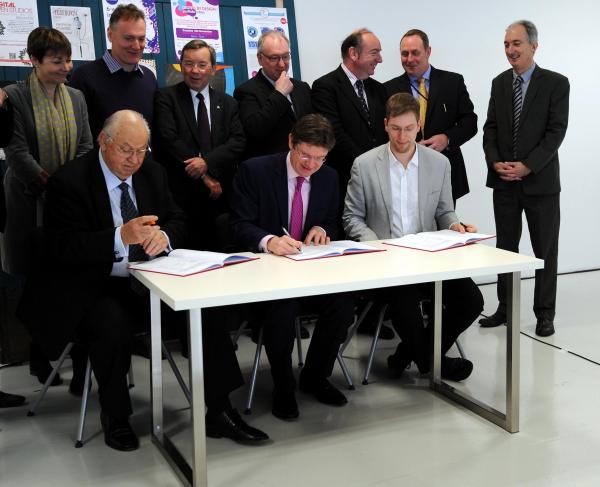
Much has happened in 2014 to put Brighton & Hove on the map. After working with our neighbouring areas – including councils, universities and businesses – we won ‘City Deal’ status from government, bringing millions of pound of investment to our Greater Brighton region. This includes government funds to upgrade the facilities for technology and digital businesses at New England House.
Signing the Greater Brighton City Deal at Wired Sussex’s FuseBox in New England House
We’ve worked very closely with the Coast 2 Capital Local Enterprise Partnership and Wired Sussex to win a number of big investments from government and Europe. Particularly close to my heart was winning a Digital Catapult Centre for Brighton.
In the summer we were also named the third best city in the country for small and medium sized businesses to grow, and we had record visitor numbers of 10m people coming to the city. We hope to keep growing that number having started work on building the iconic i360 observation tower and begun the process of building a new world-class conference centre as part of the ‘Brighton Waterfront’ project.
We won the City of the Year Award in Europe, for our work on sustainable travel. Figures this year showed that the number of people killed and injured on our city streets had fallen – meaning our work to improve travel safety is paying off.
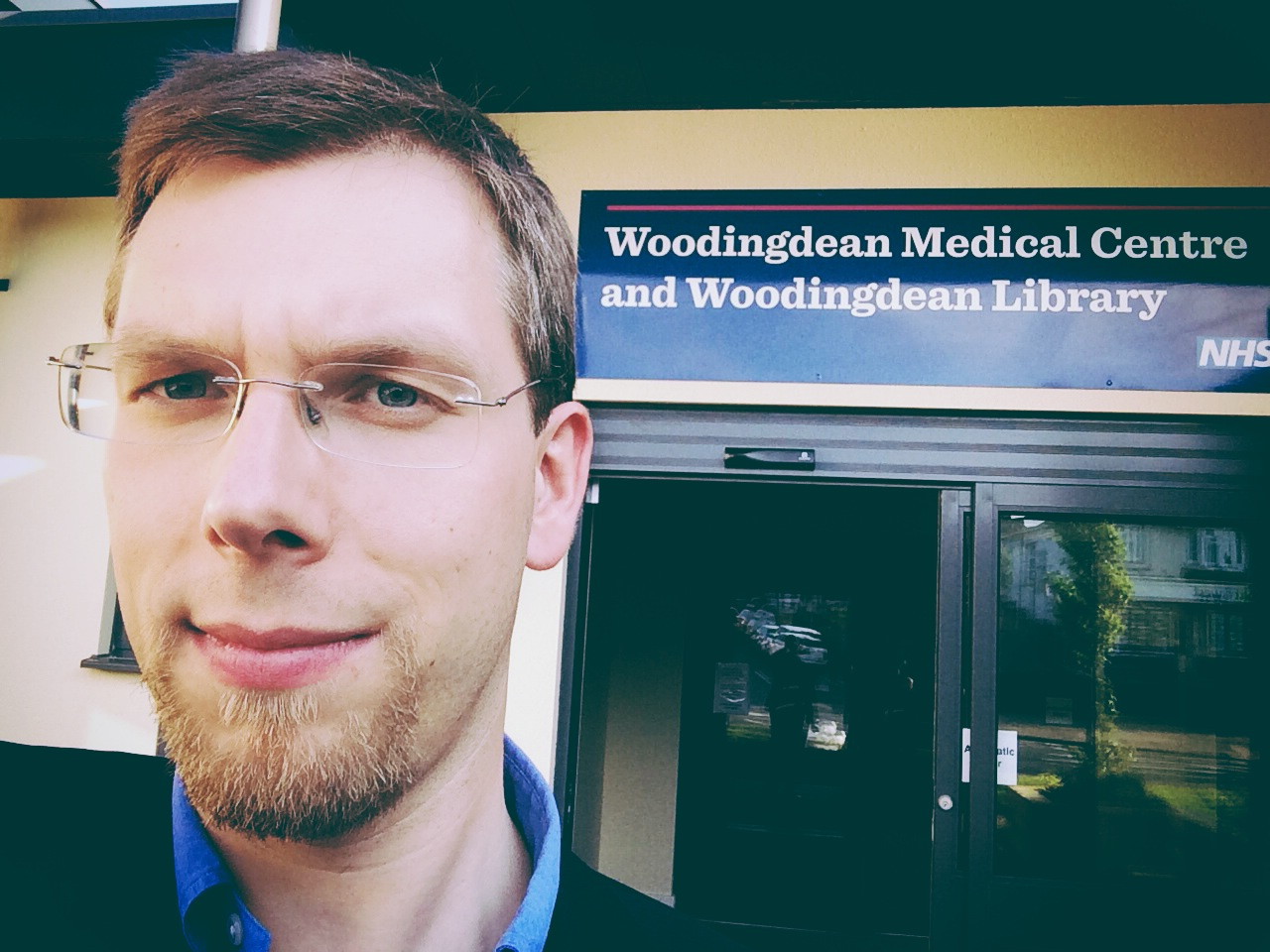
This year we also opened two new libraries at Woodingdean and Mile Oak, creating new community hubs for residents to access books and the Internet at a time when most other councils are closing them. We also pioneered, with Sussex Police and Rise, drop-in domestic violence surgeries in council customer service centres.
I started chairing the Health & Wellbeing Board this year, which was significantly reformed to bring together health and council colleagues together on an equal footing for the first time.
2014 has not been without its challenges, but 2015 brings opportunities to address them. Council officers are working on redesigning the refuse and recycling department to give residents an improved service. Work is also due to begin on a permanent travellers’ site, which will help reduce the unauthorised encampments that have disrupted residents and businesses for many years.
The council is consulting on what is going to be its toughest budget yet, now that our government funding has been cut by some 40%. The debate comes to a head in February when councillors will be agreeing the budget and deciding how best to fund and provide services for residents for the year ahead. After years of dwindling funds for local services, this time mounting government cuts are going to hurt. Combined with the general and local elections in May, it’s certain that 2015 will be an extraordinary year for our city. My best wishes to you all for the New Year.
The Coalition Government’s relentless cuts to councils, led by Secretary of State Eric Pickles, has created an extraordinary situation: Councillors of all parties across the country are united in their disgust at the way in which councils are being treated.
In recent days alone we’ve heard the Conservative Chair of the Local Government Association, Sir Merrick Cockell, warn once again of the devastating effects of the continued austerity measures imposed on councils. Sir Merrick’s successor as LGA Chair, Labour’s David Sparks, has also this week spoken out against the unsustainable funding situation facing council services. Meanwhile similar warning’s are being issued by the Association of Directors of Adult Social Services (ADASS), the Rowntree trusts and many more.
There is a great deal of unity in expressing our deep concern about these national policies. We know we are only halfway through the government’s austerity programme, one which is set to continue regardless of who forms the next government after the general election.
But when it comes to the local decisions of how to best cope with these cuts, the differences start to emerge. Even experienced opposition councillors, who know options are few, can’t help themselves but blame the situation on whoever the incumbent party is. Local voters are too busy leading their lives to notice that across the country council administrations of every political hue are being forced to cut back.
All councils face the same crunch: Huge year on year reductions in government funding whilst service demand grows as the population increases, ages and health needs grow more complex.
In Brighton & Hove we face a £25 million hole in our budget for the next financial year, £18 million of that as a direct result of government cuts and the remainder due to increased pressure for our services.
As a Green minority administration we are committed to protecting the essential public services that our citizens depend on. So we will continue with a ‘value for money’ efficiency programme which has saved tens of millions so far. But that won’t be enough so we are also proposing a 5.9% council tax increase for next year. This is equivalent to £1.48 more per week for the usual comparator of a band D household, though the majority of homes in Brighton & Hove are in bands A to C.
This increase won’t plug the hole completely, but it will give us enough breathing room to retain public services, particularly social services for adults and children. We know that by making such bold proposals there is much greater engagement by residents in the realities of the huge challenges facing council finances. As the debates developed we’ve seen many agree that a greater contribution through council tax is needed to protect the services they value.
Opposition parties will continue to utter empty platitudes about the need to be more efficient and cut down on management, but citizens deserve better than such comments which could never plug our budget gap. We’ve saved tens of millions in efficiencies already, and reduced management spend to its lowest ever. Rather than having a go at each other, residents need their councillors to work together on the huge challenges ahead.
As a Green I’m committed to protecting public services, reducing inequality and improving my city’s wellbeing. These are particularly tough challenges at a time when budgets are being squeezed so hard. Yet I do believe that by backing a 5.9% tax increase we can keep supporting those in need while keeping Brighton & Hove great.
In 2010 as a family we agreed that, if re-selected for the 2011 council elections, this would be my last term on the council, and so it will be. It has been a huge honour and privilege to serve the residents of Regency ward since 2007, it’s a wonderful area to represent. To have been able to serve my second term as a councillor in administration, leading our city, has also been an immense honour.
In dealing with the challenges we’ve faced, I’ve done all I can to contribute positively to our city for the benefit of all who live, work and visit here. I’m proud of what we’ve been able to achieve as a Green administration that I have led since 2012.
However at this stage in my life I am ready for a new challenge. I won’t be pursuing active politics any longer but do want to continue public service in some way. I have no firm plans as yet and intend to continue in my current role until the council term ends as there’s lots still to do.
This has been my decision, taken with my family.
My passion for our city is undiminished and I wish all those involved with continuing to support our city’s wellbeing the very best. You have my support and admiration.
As the debate continues around our plans for a social care referendum, lots are keen to learn more about social care. Which is good news and exactly what we have been hoping for.
Scope and Age UK provide some of the best online resources, I’ve included two of their videos here, but do visit Scope’s Britain Cares and Age UK’s Campaign for Better Care to find out more.
This is the second and concluding part on why now is the time for the citizens of Brighton & Hove to be asked whether they will support a 4.75% tax increase to protect council social care services. Part One is here.
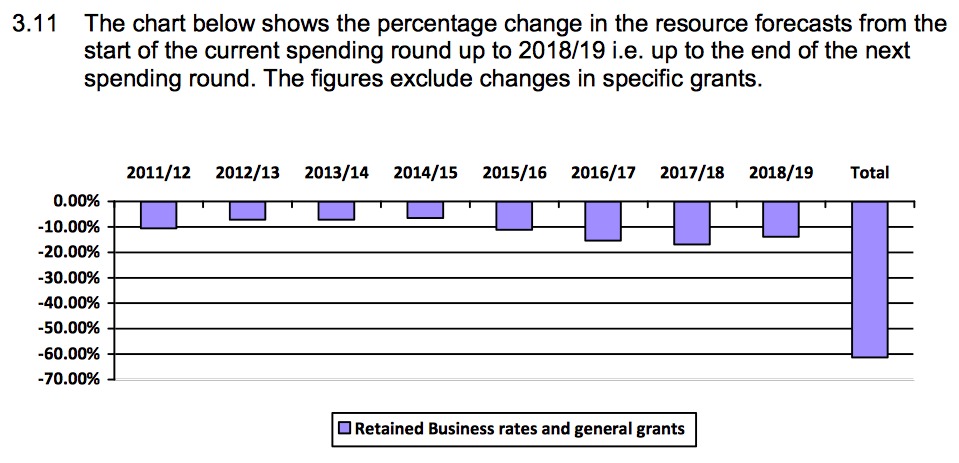
Here in Brighton & Hove we have tried to absorb as much of the budget pressures as possible through being more efficient, more flexible and by reducing our footprint – in other words fitting our staff into fewer, more sustainable and efficient offices. This has yielded significant savings, but it won’t be enough for the very significant drops in funding the government plans over the next two years. In July 2013, based on government statements, council officers made their best predictions on how our core funding will drop in the coming years. Here’s their graph:
So in the face of this we do need to find more efficient ways of working – we have no choice. But we also need to raise money. We are looking at new ways of generating income, but those will take some time to pay dividends. More immediately we could increase fees and charges, but this isn’t always desirable, could only go so far and couldn’t possibly raise enough.
So the last option we are left with is council tax. It is an option that Eric Pickles has done his best to undermine and control local decisions with gimmicks like a ‘tax freeze grant’ and by adding an ‘excessive tax threshold’ over which councils are forced to seek permission for the increase through a referendum which can only be held after tax bills have gone out.
However for all its many imperfections, those with the biggest homes do pay more council tax and the poorest do get help paying it through our discount scheme known as ‘Council Tax Reduction’.
First though we need to understand the recent history of council tax in the city. In the last year of the Conservative administration they originally proposed a -1% council tax reduction, but this was amended to a freeze. Labour had originally agreed with us to still refuse the overall budget and revisit some of the other options. Sadly in the end Labour reneged, and supported the freeze. The next year Labour passed an amendment, backed by the Tories, to our first budget reducing a 3.5% council tax rise down to a freeze. It was only the year after that Labour, at the last moment, decided to support a 1.96% council tax rise.
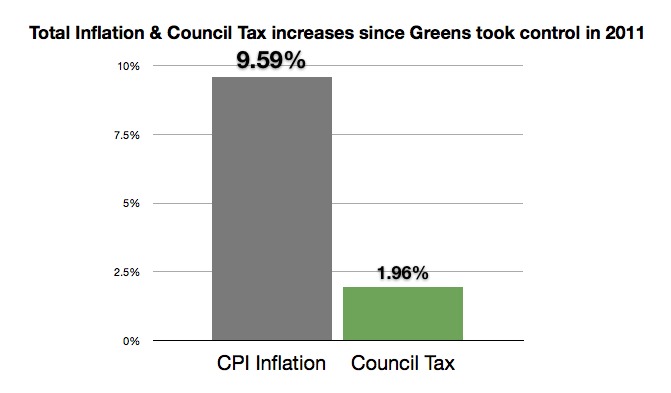
Even setting aside the scale of government cuts in relation to our budget, what do these successive freezes do for the council’s financial position when compared with the pressures of inflation. This graph shows the situation since Greens took administration in 2011:
As you can see, in real terms one of the only sources of income the council has influence over, is hugely behind inflation. It’s so far behind that it barely scrapes the surface of growing demand and government cuts. The imposition of a freeze by Labour and Tories in 2012 alone means that we have £3.7m less in the 2014/15 budget. Indeed we have cumulatively had £8.5m less since 2012 when compared with what our 3.5% proposal would have done. This additional income would have quite probably meant that we could have kept to a 2% rise for 2014/15. Many warned that freezes back then would lead to higher tax increases later, and this is proving to be case. Smaller, regular increases as we proposed was responsible, long-term thinking. Sadly, as Eric Pickles knew, too many were unable to resist the temptations of the short-termist freeze approach.
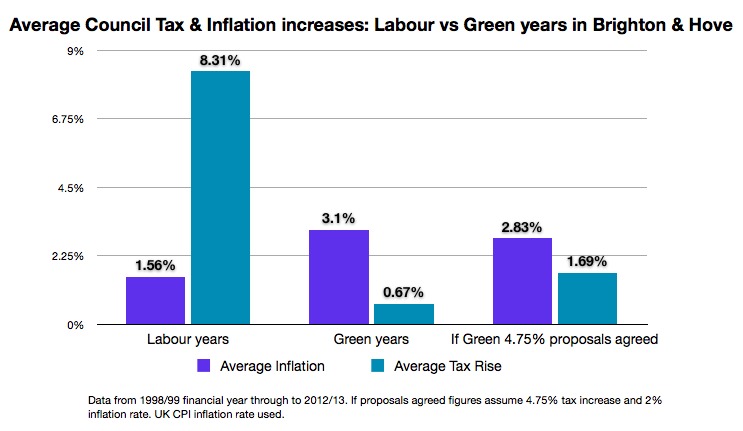
Let’s put all this history and our 4.75% proposal into perspective. Firstly let’s look at the average inflation and tax rises during our term in office and Labour’s terms:
Clearly Labour’s tax rises were far above inflation, while ours have been significantly below, even if the 4.75% proposal was to be agreed. And this was during the time of plenty. So in real terms council tax bills have been declining in value under Greens.
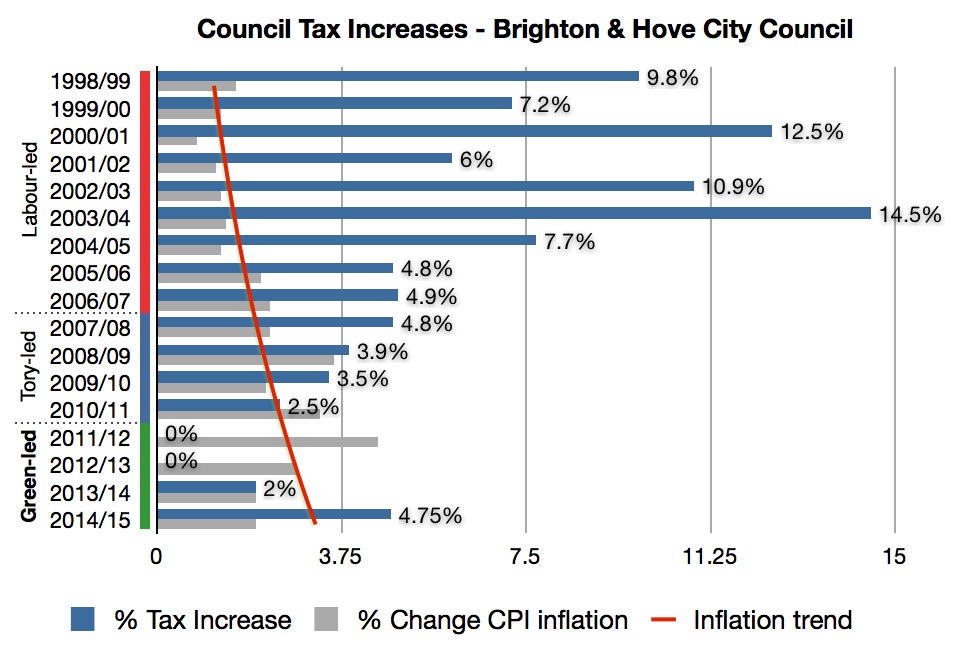
Now let’s look at the whole picture of tax increases and inflation since the city council was formed:
Click for full sized graph
It’s important to note that the first budget of each administration is actually set by the previous administration just before the elections. So the 2011/12 budget, which we had to implement, was set by Tories in February 2011 just before we became the largest party in May 2011.
Clearly no party represented on the council today was averse to tax increases at one point or another when they were in charge. That continues to be the case: Right now we see Conservative-led councils like Kent advocating 2% increases and Sussex’s Conservative Police & Crime Commissioner just approving a 3.6% increase to her precept. Labour councils are seeking tax increases too and we see Labour council leaders backing our referendum proposal including from Preston and Brent.
What would our proposal cost? Setting aside Police and Fire precepts, which we don’t control, for our 4.75% proposals the majority of households would pay an additional £4.53 or less a month. It would raise £2.75m more than in our draft budget from December 2013 when we planned for a 2% rise. The extra money raised would go exclusively to protecting Home Care, Community Care, the supported employment service ‘Able & Willing’, and third sector grants. The nature of the budget and referendum processes mean it will be cast iron that the additional money raised would have to go to those services.
***
So there we have it. Our population is ageing, adding significant additional pressures on council budgets as we strive to deliver the care our most vulnerable deserve. We have an unprecedented scale of government funding cuts – which councils and political parties across the country agree is setting us up for a huge funding gap. And lastly, we have in recent years locally seen council tax fall well behind inflation meaning that it is not really contributing to relieving our intense funding pressures.
Social care is the council’s biggest area of spending, and is responsible for the most vulnerable in our society. The picture I’ve painted above shows that carrying on, even with the most clever efficiency savings we can possibly deliver, will mean a severe reduction in what care we can offer. I hope that isn’t what we want for our society. But now is the time to have the debate. The referendum process defined by government is imperfect, but it’s all we’ve got right now.
Some in the media want to skip straight to whether people will vote for or against the referendum question. That’s premature, right now we need to debate the reasoning for the referendum as I have set out here. We must discuss the principle of letting the city decide at this critical juncture for the future our public services, otherwise we risk this precious opportunity being rejected out of hand by a few councillors.
I believe it is right and just to ask the citizens of Brighton & Hove, before it is too late, “What future do you want for our elderly, disabled and vulnerable?”
The Brighton & Hove Independent are hosting a free public debate on the social care referendum on Monday 10th February at 7pm. Free tickets can be booked here.
Opposition parties have tried to throw as much sand in the eyes of the public with a colourful array of false and misleading claims. I won’t dignify them further other than to say how unedifying it has been to see political leaders doing everything they can to avoid debating the genuine issues at hand: the huge financial pressures councils are under and the growing uncertainty over how social care can be provided into the future.
Let’s be clear, the reason I’ve proposed a referendum on a 4.75% tax rise for social care is because I think it’s the right thing to do. Let me now explain why in more detail.
In 2011 we made a commitment to publishing early drafts of council budgets to facilitate the consultation and engagement process. Every year so far the final budgets have changed for the better as a result of this process. It’s the right way to do things when we have to decide on the future of important services for our city. We did the same again this year and the feedback from the public, service users, advocacy groups and unions was clear. They were very concerned about the impact of budget cuts on the third sector and social care in particular. They’re not alone – the majority responding to the council’s budget questionnaire wanted funding to be maintained or increased for local services. Yet because of government cuts and growing demand for our services , we will have to spend £23m less for the coming 2014/15 financial year.
Why is social care under particular pressure? Well the number of people who need social care is growing. This includes those with physical and learning disabilities as well as the elderly. It’s no secret that as we are all living longer, the cost of social care is growing. Here’s a snapshot – looking at centenarians as just one of many examples – of how the ageing population is expected to grow in the coming years:
Growth of centenarians in the UK
Let’s bring that into the local context. Here are the ONS’ predictions for our city until 2021 along side the change in council funding from Government in a similar period:
Future population & council funding changes
Yes, the graph really does show over 85s increasing in number by 20% and at the same time our government funding declining by 61%. This is why the cross-party Local Government Association has been doing increasingly detailed work on making clear the huge pressures councils face as austerity continues and pressures on services grows. This graph shows their predictions for unitary councils like Brighton & Hove:
LGA unitary council funding forecast
The gap between funding available and funding needed for existing services is incredibly stark: This is not for new or extra services – but just to keep things going. In local government circles this has been debated, with increasing angst, for some time. But it’s sadly the case that too little of this reality has entered public debate.
Some have claimed that this is special pleading by the Greens but that’s simply not true. The Local Government Association has a cross-party consensus on the issue and their chairman, the Conservative Sir Merrick Cockell, has led the charge. Sir Merrick, also the former leader of Kensington & Chelsea Council has said:
“We are being pushed into a position where either things will fail or the system has to change … we can’t cope unless someone takes that big step … to change the way we operate … Vital services are being damaged because councils do not have a seat at the table to negotiate a fair deal for their communities.”
Similarly the Labour leader of Birmingham City Council, Sir Albert Bore has said:
“Birmingham faces a severe financial crisis. Politicians in Westminster are systematically dismantling services that maintain the very fabric of culture and community here.”
“These cuts will mean the end of local government as we know it … but that does not mean the end of local government. We now need to build the new local government that will replace it. We call on the government to make radical changes to the way local services are funded and provided.”
The Independent Mayor of Bristol, George Ferguson, has said:
“…every city in the UK is facing a massive budget challenge… It will not be without pain… No number of negative headlines will change the fundamentals: we [the city council] must balance our books…”
The Conservative leader of Devon County Council has said to local government ministers:
“The impact of [the] spending review has not been accurately portrayed… We cannot make these extra savings without reducing substantially the services we offer to the people of Devon.”
And the Labour Mayor of Liverpool Joe Anderson has said:
“I believe community cohesion is being seriously threatened by the lack of funding to our city and others. I believe that the so-called ‘summer-of-discontent’ will happen again if we do not address this issue.”
So the problems of funding cuts are real, are being expressed loudly by all parties and are already hurting local services across the land.
In part two I will look in more detail at the particular situation we find ourselves in Brighton & Hove and why I believe our proposal is the right way to proceed. UPDATE: Part two has now been published.
Readers will know that public services have for the last few years seen significant government cuts. Here in Brighton & Hove we have so far been successful in protecting essential services by saving tens of millions of pounds through genuine efficiencies. But darker storm clouds are on the horizon.
Councils are facing what many are calling ‘a cliff edge’ in funding, and as a result huge chunks of services could disappear. Simply put, we can no longer absorb all of the government’s cuts whilst also meeting the increasing demand for our services from a growing yet ageing population.
Nationally councils have seen a 38% reduction in funding compared to Government only 8% trimming of Whitehall departments. And sadly, per head of population, Brighton & Hove has been one of the worst hit councils in the country.
We want to offer you, the residents of our city, a choice: accept the full weight of austerity cuts imposed on Brighton & Hove by Eric Pickles or else cast a vote for a fairer and more compassionate society. Let the coalition cuts take their toll, or agree to pay a little bit extra each month to fund care for older and disabled people in our community and protect funding for the city’s charities.
The increase in council tax we’re asking of residents will not only save services this year, but will improve their security for years to come. If agreed, the money will specifically go towards supporting home care, residential community care, day services, support for those with learning disabilities looking for work – as well as protecting grants to the city’s third sector.
The elderly have worked hard all their lives and deserve our continued support in their old age. And the city’s charities, social enterprises and not-for-profit organisations also provide essential services across all our city’s communities. We know that investment in our third sector benefits the city and residents many times over. Without additional funding, the Coalition’s cuts will seriously impact upon some of the most vulnerable people in our city.
We think it’s right that we trust the residents of Brighton and Hove to decide what they want from local services – particularly given the financial situation is so different to that when they voted in 2011. So we want to hold a citywide referendum in May 2014 on whether we should raise council tax by 4.75% for the coming financial year.
We ask the people of the city to vote in favour; to reject austerity in Brighton and Hove and help us to preserve a more compassionate society, one which cares for older and disabled people, supports social enterprises and protects the not-for-profit sector that is so vital to so many in our community.
The past year has been a challenging, but good, year for our city. We continue to outpace the national economic recovery with rising employment figures, low levels of shop vacancies and visitor numbers continuing to do well. Our schools, colleges and universities are all growing and outcomes are improving, indeed this year saw record GCSE results against a nationwide downward trend.
2013 saw Brighton & Hove Albion and the city council, win the right to host 2015 Rugby World Cup matches in the Amex stadium. The city’s wonderful Festival and the Fringe both had record years, and our museums have been doing very well. Public art and photography have continued popping up across the city thanks to a diversity of projects. Pride was better than ever this summer, and has plans afoot to do even more next year. The Brighton Marathon also had a bumper year and announced exciting plans for 2014. And we saw a Royal visit to open The Keep, our new public archives in Falmer.
Nevertheless our wonderful retail sector faces challenges as shopping habits change to online and household disposable incomes continue to feel the squeeze. Sadly many have less in their pockets each week, not just in inflation-adjusted ‘real’ terms as economists say, but because of sustained government cuts to welfare. Whilst most agree the welfare system needs reform and simplification, little of that promised change has happened. So far we’ve just seen measures that by 2015 will have taken £15 billion out of support for the poorest. In many cases councils are picking up the pieces. For example the benefit cap costs the council £1m a year to keep families in their homes and prevent homelessness. The government is celebrating the reduced benefits bills, whilst we, the local taxpayers pay the price.
These years were always going to be challenging for local councils. With an ageing population and a baby boom, we have more demand than ever before. We are helping thousands more people each year through our 800 council services. This increase alone is a pressure of £10-15m a year. Yet, we have a government not just failing to recognise and help us with that growing demand – but cutting our funding, making the situation worse. By 2015 councils will have seen a 40% cut in funding just as their services are in greater need than ever.
Unfortunately the austerity consensus between Tories and Labour in Westminster means that this situation will only continue. We have to do the best for the city in the circumstances – so what has been happening?
Many readers will have noticed the major transport improvements completed this year, thanks to external funding from the Department for Transport and others. The Lewes Road and Seven Dials have been transformed, improving safety for all. Brighton & Hove remains one of the ten worst areas in the UK for road safety, so more work is needed. We’ve also been successful in rolling out 20mph limits where residents support it. Thanks to these transport measures we’re seeing walking, cycling and bus use all growing significantly – crucial when we have more and more people living, working and visiting the city.
We’ve taken made major progress on big developments in the city We’ve moved forward with the University of Brighton on developing Preston Barracks, and announced our plan to sell our seafront headquarters, Kings House. Lots of building has been underway such as the old Co-op on London Road, ‘Block J’ behind Brighton station, Woodingdean’s new library, the Brighton Housing Trust container homes and the Amex stadium expansion. We’ve also completed a major refurbishment of the Withdean Sports Complex and a number of council offices. Part of this involves working more closely with other public sector organisations – for example we now share Hove Town Hall with Sussex Police. Our parks and open spaces have seen lots of work this year too including installing chalky ‘butterfly banks’ and the revamped facilities at The Level .
It’s been a busy year for negotiating with government. After winning money for ultrafast broadband in late 2012, this year has been spent pushing government to let us spend it as they wrangled with suppliers and the EU. This was finally resolved a few weeks ago so 2014 should be an ultrafast year for the city. We’ve also been negotiating with government for a ‘City Deal’ to support the so-called Greater Brighton region. Clearly our residents’ lives don’t stop at municipal borders – so it’s important that we work with our neighbours to make progress together. At the time of writing we are very close to sealing an agreement which will support key developments across the city region to unlock economic development and empower our area.
This year we also completed the long overdue process of ensuring equal pay for all council workers. This should have been done more than a decade ago, but the political and logistical difficulties of doing so meant it was never fully tackled.. I know how difficult and unpleasant the dispute and subsequent strile was for all involved. But the end result is we now have clear and fair pay and allowances for all council workers and we’ve avoided the risk of legal challenges which could have left the council bankrupt.
We’ve also had great success with the living wage campaign. The council was accredited as a living wage employer this year, and a few weeks back the campaign celebrated over 100 local employers providing a living wage or more to all their staff. The campaign is led by the city’s Chamber of Commerce with council support, the only campaign of this type in the UK. Thanks to its work, over a quarter of the living wage employers in the UK are right here in Brighton & Hove – a wonderful milestone.
In April we were recognised as the world’s first One Planet City by sustainability charity BioRegional. This means our plans to reduce our environmental impact have been independently assessed to be credible, but we’ve still go to do the work of implementing them. That work is well underway.
We as a Green Group of councillors published our mid-term report in the Autumn which showed our strong record of delivery since May 2011. Three quarters of our manifesto commitments have been done or are on course to be completed. Straight after that the city hosted the Green Party conference in the city, followed by the Labour Party conference – both great for the local economy.
Looking ahead to 2014, we’ll need to complete the very challenging annual budget process for the 2014/15 financial year and start preparing for the 2015/16 council budget. There are no easy choices left for councils. But I’m committed to doing the best we can for citizens with whatever government leaves us in our spending pot.
In 2014 I hope to be signing the Greater Brighton City Deal with government and seeing developments move quickly after that. Almost immediately we will be working with our Local Enterprise Partnership to negotiate a ‘Growth Deal’ between government and our region. This will be our main source of funding for transport projects in the city in the future, a successful deal is crucial.
Meanwhile we’ll be completing the rollout of communal recycling and pay by phone parking in the city. We also have major work to do on the seafront ,balancing our local economy whilst finding the £100m cost of maintaining the rapidly ageing structures holding up the promenade.
Another absolutely key task is transforming social care and the local health system overall. Almost everyone agrees that council social care and the NHS need to work better together to improve services for our residents and make sure it’s affordable.
Many challenges and opportunities lie ahead in 2014. We will keep supporting those in need, helping local businesses and charities while delivering services. Brighton & Hove moves into 2014 in a strong position, with a creative energy ready to surprise and impress as we continue to attract visitors from far and wide. Merry Christmas and a Happy New Year.
Below are two letters to Mr Duncan Smith highlighting serious concerns about how his department is treating local government.
To Iain Duncan Smith in the Department for Work and Pensions:
Dear Secretary of State,
We appreciate that the introduction of Universal Credit is no longer on the government’s original timetable. While delays that help ensure effective implementation are to be welcomed, I need to alert you that this creates additional financial pressures for councils.
You may be aware that the administration of housing benefit is funded by a specific grant from the Department for Work and Pensions (DWP). I am sure the original intention of this grant was to fully support local government in providing a service on its behalf. However unfortunately its costs have long outstripped its funding – in the latest national comparative figures available, 2012/13 national Housing Benefit Administration expenditure was expected to be 74% higher than the grant ( 102% in London and 69% in Unitary authorities) and for Brighton & Hove this was 98% – representing a subsidy from the council’s General fund of £2.938m. The administration grant continues to be subject to reductions, 10% for 2014/15 and yet the delays to the implementation of Universal Credit alongside reforms mean that efficiency savings of this magnitude are increasingly challenging. For example as individuals find they need to take more than one job or find themselves moving in and out of work more frequently so their circumstances require more frequent reassessing from a benefits perspective. This adds additional cost and complexity that will only be resolved at the point at which Universal Credit is introduced. In 2014/15 the gap between expenditure and income for Housing Benefits for Brighton & Hove is expected to be £3.397m – a direct subsidy from the council’s General Fund to deliver a DWP programme. While the council continues to review and benchmark its service against comparable local authorities, there is no evidence at the moment that this is out of line with others.
We appreciate that there is a desire to constantly improve efficiency and reduce costs to the taxpayer. We, like many authorities, have successfully driven down our costs while maintaining high standards of service. However there does come a point, when service effectiveness is a matter of having enough resource to meet demand and while we continue to strive to make our service more efficient the gap between funding and actual cost is an increasing burden that Local Government cannot afford to accept on the DWP’s behalf.
I therefore call on you to reconsider the funding position for HB admin subsidy to let our costs be covered. The money that has been taken out of the admin grant over the years makes it increasingly difficult of us to deliver this statutory social security benefit on your behalf. Other local services have had to be cut to fund our ongoing delivery of this national benefit. I do not believe taxpayers would consider this fair or justifiable.
I await your response.
Thank you
Cllr Jason Kitcat
Leader of Brighton & Hove City Council
—–
Dear Secretary of State,
Proposals to implement a Single Fraud Investigation Service (SFIS)
We are aware that the Autumn Statement 2013 has confirmed that government plans to implement a Single Fraud Investigation Service (SFIS) during 2014.
Brighton & Hove City Council is very concerned at the current plans to operate SFIS as an organisation wholly managed and operated by the Department of Work and Pensions (DWP). We believe current plans have been adopted without due consideration to local authorities’ views and without full consideration of the impact such changes would have on counter fraud activity outside of SFIS, especially those areas under the remit of local government. We would strongly urge you to reconsider how SFIS is implemented.
We recognise that SFIS could be a great opportunity to make a real difference to investigating welfare and related frauds and to work in a truly collaborative way. As it stands, we believe that local authorities will be left more vulnerable to fraud attacks if current proposals go ahead. We also believe that reported savings of operating SFIS could therefore be offset by wider fraud losses across local government.
In this council, not only do we operate a Housing Benefit investigation team but we also host one of two National Anti-Fraud Network (NAFN) offices that provides first class data and intelligence services to over 350 councils. Through these services, currently it is common for local authorities to link investigations together e.g. ‘blue badge’ fraud and benefit frauds; housing tenancy fraud and benefit fraud. Under SFIS proposals, much of the benefit of this type of combined investigation will disappear, as will any links between local authority corporate fraud work and SFIS. This simply does not make sense.
Allied to this, there will be no or limited links between SFIS investigations and Council Tax Reduction Scheme investigations. Again, a collaborative approach would be our preferred solution rather than two separate investigations undertaken by different organisations with potentially two separate prosecutions being undertaken at the same time. There is potential for significant process duplication and preventable costs.
At Brighton & Hove, in common with a number of authorities, we have recently set up a Corporate Fraud Team to undertake fraud investigations across a wider spectrum of our activities. We are concerned that the current proposals do not provide sufficient time to develop this unit and also that any work it carries out in future will be in isolation from SFIS. Again, this would not appear to be well thought through, especially with the introduction of powers to make housing tenancy fraud a criminal offence.
NAFN is recognised as a centre of excellence in local government and its services extend well beyond local authorities. For instance, NAFN processes all of the DWP’s fraud related vehicle checks. The introduction of SFIS as currently proposed would be likely to reduce NAFN resources considerably and therefore the impact on the wider fraud community in terms of protecting public funds could be considerable.
We are also concerned about the impact on localism. Centralisation of welfare benefit fraud investigations would appear to go against the grain of the localism agenda supported by the rest of government.
We would strongly urge further constructive and meaningful consultation on current proposals so that we can identify a solution that would be beneficial to all areas of central and local government.
Should you have any queries or wish to discuss the matter any further, I would be most willing to provide further information or meet you to talk through these issues.
Yours sincerely,
Councillor Jason Kitcat Councillor Leslie Hamilton
Leader of the Council Chair of the Audit & Standards Committee