Categories
notes from JK

Refreshing British Politics

There are many good reasons for people to want see a change in British politics. A key way to achieve that is going to be refreshing the cast of characters who sit in Parliament.

The lead candidates in Brighton Pavilion offer three different models for change. Conservative Charlotte Vere represents a party who want to change our country to benefit the few well off people at the expense of the majority. (I know that’s simplifying things dramatically, but that is the overall end result of Tory policies)

Labour’s Nancy Platts offers an interesting alternative approach. By rejecting many of her party’s policies she implicity suggests that, if elected, she would be a rebel campaigning for reform from within the Labour party. That’s an entirely valid approach to take, but I’m not sure how much influence Nancy actually would have within her party if she did follow through on her personal policy positions. A good number of people have already tried and failed to steer New Labour back to its original roots. (As an aside, it’s really quite extraordinary how many policies on which Nancy differs from her party e.g. Rail privatisation, ID cards, Trident, Heathrow expansion and supermarket expansion.)

Caroline Lucas for the Greens is offering an alternative, more credible, approach in my view. By getting Greens elected the breadth of views in Parliament, the diversity of representation will be meaningfully increased. Us Greens have long standing policies on social justice, workers rights, health and much more. We’ve been getting messages of support from people across the country, from all party backgrounds, wishing us well. They express their hope that some Greens will get elected to Parliament so that they open up and improve debate. It’s down to the Brighton Pavilion as to whether that will happen.

Categories
notes from JK

Connecting councillors & parliamentary candidates

Green councillors with Caroline Lucas

On the issue of council-level versus Westminster-level issues there appear to be two schools of thought emerging. One approach, which Greens are taking, is to say that everything is connected. No matter what level the decision is taken at (Europe, Westminster or Brighton & Hove City Council) it affects people here in our city. So we work closely between all levels at which we operate. That’s helped by having two of our councillors being candidates (Ian Davey in Hove and Ben Duncan in Brighton Kemptown) and of course an MEP as our Brighton Pavilion candidate.

Regardless of specific candidates, in terms of policy and worldview we tend to take a big picture view. So for example on the issue of recycling we’d like national government to set ambitious targets, provide sufficient resources and adequate legislation. We also need local councils to use all of those to provide the most user-friendly and sustainable services to facilitate recycling. That’s a view which holds at all levels of the Green Party.

The other approach to council vs Westminster is to argue that they are different and separate. This seems to be very much what the Conservatives and Labour in Brighton & Hove are adopting. Neither party seem to be showing much co-operative working between their parliamentary candidates and their elected councillors.

This was brought to mind when I met the charming Conservative candidate Charlotte Vere for a Radio Reverb panel debate on Monday. Charlotte waxed lyrical about how easy food waste collection was once you had got used to it, how fortnightly waste collection should be looked at and so on. Naturally I was quick to point out that the local Tory councillors were very much against introducing such measures despite plenty of resident demand and the compelling sustainability plus financial arguments.

Charlotte’s response was I was making ‘typical councillor arguments’ and that she didn’t deal with council stuff, she was a candidate for Parliament. Maybe there’s a cultural divide on this issue between the Greens and the old parties, but I’m surprised. Perhaps Charlotte feels that way because there seems to be scant support for her from the Pavilion Tory councillors.

Either way I think we should be linking up all levels of politics and decision making, and that’s what Greens strive for.

Categories
notes from JK

Speech: Maternity Services in Brighton & Hove

This speech was presented to the Full Council meeting of Brighton & Hove City Council on 18th March 2010. It was to propose a Green notice of motion on maternity services, which was passed by the meeting:

Amidst much downbeat news on the NHS, it is doubly worth celebrating, as this motion does, the local Primary Care Trust’s plans to introduce a midwife led birthing centre in our city.

For far too long the majority of mothers have had to trek to Crowborough for a midwife led birth or go to the Royal Sussex County hospital for a ‘standard practice’ birth. An increasing number have been wanting to have home births but the resources have not always been available to support this. Furthermore Crowborough birthing centre only has six beds – so the choice has not been a reality for many families.

Of course good, trouble-free births do happen every week at hospitals. I support the good work our local hospital does, this motion is about offering families meaningful choices.

For so-called “normal” pregnancies home and birthing centre births are just as safe, if not safer than the hospital environment. For it is in hospitals, where birth still tends to be overly medicalised, that unnecessary interventions with unintended side-effects still happen too often.

Much obstetrician thinking is still too male dominated. Doctors tend to treat birth as something that happens to a women, in the way disease happens to someone, rather than an incredible thing that women do and have been doing for millennia.

We celebrate the advances in medicine which have dramatically reduced childbirth mortality rates. But traumatic births, due to inconsiderate and inappropriate medical interventions, should be avoided wherever possible. For the trauma of a difficult birth has lasting physical and psychological impacts on mother and child, hence their partners and surrounding family too.

Women being offered epidurals, “because the anaesthetist is around now”, being strapped to monitors which restrict their movement in the critical stages of labour and being given epistomies because mums are made to deliver lying in that most unnatural position, on their backs. These are all examples of unnecessary interventions which still happen in NHS hospitals. These are actions which have a lasting impact on the wellbeing of mothers.   Medical interventions often require additional recovery and healing, hindering mothers from caring for their children in those precious early days.

Such interventions are extremely rare in midwife led-birthing centres. Midwifes have a different, more nurturing model of birth which trusts women in their ability to deliver safely and naturally. Of course they have the training and skills to deal with the complications which can occur, but most births can and do proceed without major intervention.

Birth is a life changing moment for all concerned. The mother in a state of anxiety, pain and intense physical vulnerability and the father trying to make himself useful in one way or another. A midwife is in a unique position of experience and skill to empathise with and support the expectant family.

When my wife was expecting a few short years ago, we started off with different midwives at each checkup. After a few months we were fortunate enough to be assigned to one midwife who stayed with us until a week after the birth. However for the birth itself, none of the midwives or other staff were known to us. This made a difficult situation that much more stressful. A familiar face would have made a world of a difference.

The NHS need to find a way to resource greater continuity of maternity care. This also applies to post-natal care. Midwives generally stop seeing a mother 5 to 10 days after birth. Health visitors pick up the baton from there, yet they are suffering from increasing caseloads where 70% of health visitors in one survey saying that they didn’t have time, due to their caseloads, to help even the families that are most in need. The number of health visitor home visits are in decline as are the number of clinics they run.

This leads to an increased risk that child development problems and post natal depression are less likely to be picked up. Unless parents are proactive in accessing services, they are likely to get only very occasional visits backed by postal surveys. This isn’t enough to form the bond needed to spot problems in the early days of parenting.

A good relationship with a midwife and then health visitor is vital. These are tender, challenging, vulnerable times. For the mother who wants to discuss problems she may be experiencing, for example the physical after-effects of giving birth or during breastfeeding, there must be a level of trust and understanding for them to share these concerns.

That’s why this notice of motion calls on the PCT and the Health Secretary to support greater midwife provision and post natal care. Offering counselling after a traumatic birth received near unanimous support in the PCT’s survey. Such counselling can prove vital in speeding psychological recovery. There is plenty of evidence that when not dealt with birth trauma can have an impact for years, on the mother and her relationship with those around her.

Let’s work to try and eliminate as many unnecessary birth traumas as possible, but where they do happen, let’s support parents with the best services we possibly can.

I urge you to support this motion. Thank you.

Categories
notes from JK

Speech: Opposing proposals to transform council meetings

Presented to the Full Council meeting of Brighton & Hove City Council on 18th March 2010 in relation to Item 68 of the agenda which aimed to dramatically cut the amount of time for councillors to speak and ask questions:

Sat together this evening in this chamber, we 54 councillors represent the over quarter million residents of our wonderful city. They have entrusted in us the great responsibility of the stewardship of the city and its public services. It is a duty we must undertake with humility, dedication and honour.

When seeing the proposals before us to restrict debates, limit member questions and guillotine meetings; one must ask — is the duty of public service too great for some? Are eight meetings of this council a year too many? Are a few long meetings too much to take when debating this city’s wellbeing?

The proposals suggest four hours is the most we should endure in a council meeting. That equates to less than half a second for each resident of this city. Is that really the most we can offer? On this side of the chamber we feel matters should be debated fully and properly.

I believe the sterile, unopposed cabinet system is seeping too far into this Council’s constitution. Despite their very public wailing and gnashing of teeth, Labour and Tory councillors forced through the new cabinet system. Now full council meetings are the only forum in which members have an absolute right to speak. At every other meeting we can only speak with the chair’s permission, leaving full council the last preserve of free debate between members. Yet these proposals, which both Labour and Tories are reportedly happy to wave through, further reduce the opportunity for dissent and debate.

We are not clerks trying to speed up some repetitious process. We are democratically elected representatives. We follow in a long line stretching all the way back to the elected senators of ancient Athens where discourse was a thing of note. I believe we should aspire to greatness in this chamber instead of this appalling streamlining.

Let us examine the report presenting these unwelcome proposals. We must first reject the notion that more motions or more questions are inherently something to be avoided, in my view they reflect a healthy interest in the workings of the council.

I must say the appendices are deeply misleading and unhelpful. They cite no councils with our status of no overall control, nor our diversity of elected parties. For example Westminster City Council is overwhelmingly Conservative, with a few Labour councillors and no other parties. Southampton: Again Conservative majority with two other parties. Same again for West Sussex.

If one looks in appendix 2 at the number of notices of motion per council meeting, it is notable that we seem to be unique in having so many of our scant meetings taken up with special business which blocks such motions, these meetings include the budget and the mayor making. Greens strongly feel that the most sensible way to spread the load would be to have more full council meetings. This is especially vital given they are the only place where we can all debate issues freely.

Cllr Fryer will speak to our amendment 6. We are withdrawing amendment 5 as officer clarification has shown it to be unnecessary. I shall address the remainder now in reverse order.

Given the importance of freedom of expression we oppose the reduction in speaking times and propose an amendment accordingly. We must allow ourselves 10 minutes to develop an argument properly, anything less is only going lead to a poorer quality of debate.

Similarly, capping the number of notices of motion allowed merely acts to limit our freedom of speech. It is impossible to know which issues will arise and sometimes two motions won’t be enough to deal with the matters at hand. Opposition councillors have scant opportunities to formally seek support for issues they consider important, we must defend this avenue hence our amendment on this issue.

On the matter of questions, an issue dear to my heart, the picture is more mixed. I welcome the opportunity for a system of written questions akin to that used in Parliament. However, the proposed oral questions procedure is half baked. Limiting members to only one oral question each, plus a supplementary, will block comprehensive attempts in holding an administration to account.

Members each have their own areas of expertise and ward interests. At certain times, say of industrial action or a heat wave, their knowledge in asking pointed questions is valuable to the whole council and residents in getting to the bottom of an issue.

If the concern is about the time questions take, perhaps the Conservatives would pledge to stop asking pre-arranged questions of each other? This offer has not been forthcoming; so again we propose amendments to the recommendations on member questions.

Finally with regards to automatically closing meetings after 4 hours. As I mentioned, I don’t believe a few long council meetings a year is too much for our residents to ask of us. And of course the meetings continue to have rule 17 to allow a closure motion if absolutely necessary. Automatic closure is unnecessary and undemocratic in our view.

All these items come back to the question of what are we here in this chamber for: Is it for the efficient despatch of business or to properly deliberate matters on behalf of residents? We believe it is the latter and this requires a decent amount of time.

Who of us here tonight hasn’t referred to one of Churchill’s great speeches or bemoaned the increasing focus on soundbite politics? Yet if these proposals go through there will be no time for Churchillian speechifying, all we will have time for will be the soundbites most claim to decry. If these proposals are approved, we will be doing a huge disservice to ourselves and those we are elected to represent.

I urge you to reconsider this matter and support the Green amendments. Thank you.

GREEN GROUP AMENDMENTS

ITEM 68 – Proposals for Transforming Meetings of Full Council

Council Meeting 18th March 2010

Amendment 1.

To remove the automatic closure of council meetings after 4 hours, ensuring matters of importance to the city are fully debated.

DELETE 4.3 and REPLACE with “4.3 Members should note that a meeting can be closed by use of Council Procedure Rule 17.”

Amendment 2.

To remove arbitrary limits from member questions so that issues can be fully explored and administration Councillors can be properly held to account.

DELETE 5.4 (a) and DELETE the final sentence of 5.4 (d) so that it reads:

“5.4 (d) A Member asking a question (but not others) may ask one supplementary. No Member may ask more than one question.”

Amendment 3.

To remove the proposed limit in the number of Notices of Motions that can be submitted, thus keeping freedom of expression for all Councillors.

DELETE 6.2 (i) and (ii) and REPLACE with “6.2 Members should keep in mind the length of Council meetings when submitting Notices of Motion.”

Amendment 4.

To retain existing time limits for speakers at Council meetings to allow proper debate.

REPLACE 8.2 (i) with “8.2 (i) Speaking time limits will remain unchanged at 10 minutes for proposers and 5 minutes for other speakers.”

Amendment 5. [WITHDRAWN]

To require cross-party support for second extensions for speakers so that the administration party cannot keep voting extensions for their speakers.

ADD 8.2 (iii) “Second extensions of speaker time will only be granted with the agreement of the Council including at least one member of another political party or an independent member.”

Amendment 6.

To split the mayor-making from the standard business of the annual Council meeting so that debate can be held on appointments and other business.

ADD a new recommendation 2.2 (iv):

“The annual Council meeting will be held in two parts. The ordinary business including agreement of leadership, committee and external appointments will be held first. After a 15 minute break during which guests can be seated, the Mayor-making will commence.”

Proposed by: Cllr Jason Kitcat

Seconded by: Cllr Rachel Fryer
Categories
notes from JK

Speech: Supporting Green environmental amendments

I had the task of speaking to our budget amendments which dealt with environmental issues. Unfortunately none of them gained enough support to go through.

—-

Budgets always present difficult choices — we can’t possibly afford to address all the issues we’d like to. The Green Group feel that the proposed Conservative budget does not best address the most urgent issues facing our city’s residents.

We are proposing four simple, cost effective measures that will improve residents’ quality of life. These measures will also contribute to safeguarding our environment. The proposals I’m speaking to are:

  • Free home insulation for 900 families in lower council tax bands.
  • Protecting people from noise disturbance with additional noise team patrols.
  • Promoting garden and food waste collections.
  • A downland protection fund to preserve our unique countryside landscape.

Despite recent small drops in fuel costs, overall household fuel bills have been on the rise for the past few years. Our home insulation proposal will save money for families on lower council tax bands whilst also reducing the emissions from heating their homes.

With regards to noise, the recent studentification scrutiny panel highlighted the need for more support for residents when faced with noise nuisance. The 2003 Licensing Act has also unleashed far more disturbance on the city’s residents. More shifts from the noise team will allow more residents to seek relief from noise and get a good night’s sleep.

It costs us, as a Council, more to ship waste to landfill or incineration than it costs to recycle it. So it makes financial as well as environmental sense to seek alternatives. Our amendments seek to bring in a garden green waste collection scheme at zero overall cost to the tax payer. Residents will pay to subscribe to the regular doorstep collections, at a substantial saving compared to commercial green waste collections. Where possible we would encourage people to compost at home, but many are unable to do so and need an alternative. This measure has had great support from the Older Peoples’ Council.

Whilst garden green waste is 10%, food makes up 35% of our municipal waste. To make a significant impact on our waste levels and meet our recycling targets, we need to tackle food waste. Our proposal aims to update work previously done to ensure the viability, logistics and detail of a food waste collection in the city. Many people, especially in flats, don’t have room to home compost so municipal food and garden waste collections are essential.

Finally we are proposing a Downland Protection Fund to preserve our unique countryside landscape. This fund would support a number of measures to protect precious downland ecosystems and has received widespread support from local associations. Measures include mowing, composting and bringing forward sheep grazing, which we support.

I urge you to support our amendments.

Categories
notes from JK

Brighton Pavilion: A graphing battleground

Which graph do you think best describes the chances of parties in the fight for Brighton Pavilion constituency? The most recent election, poll or perhaps the last general election in the constituency? In their attempts to woo voters both Labour’s Nancy Platts and Conservative Charlotte Vere are making some interesting choices with their graphs.

Why do election graphs even matter? Because our perverse electoral system means you just need a majority of one vote to win the seat. Many people don’t want to see their votes get wasted by voting for third or fourth parties who don’t have a chance of winning. So we have tactical voting – people voting for the least worst winnable option in their opinion. As a result all the parties vie to show how good their chances of winning really are.

Personally I think you’re only as good as your last electoral test. Yes different voting systems and types of election will influence how people vote – for example, UKIP do vastly better in Euro than local elections. However, for the same place, each election does build a picture of the relative strengths of local parties.

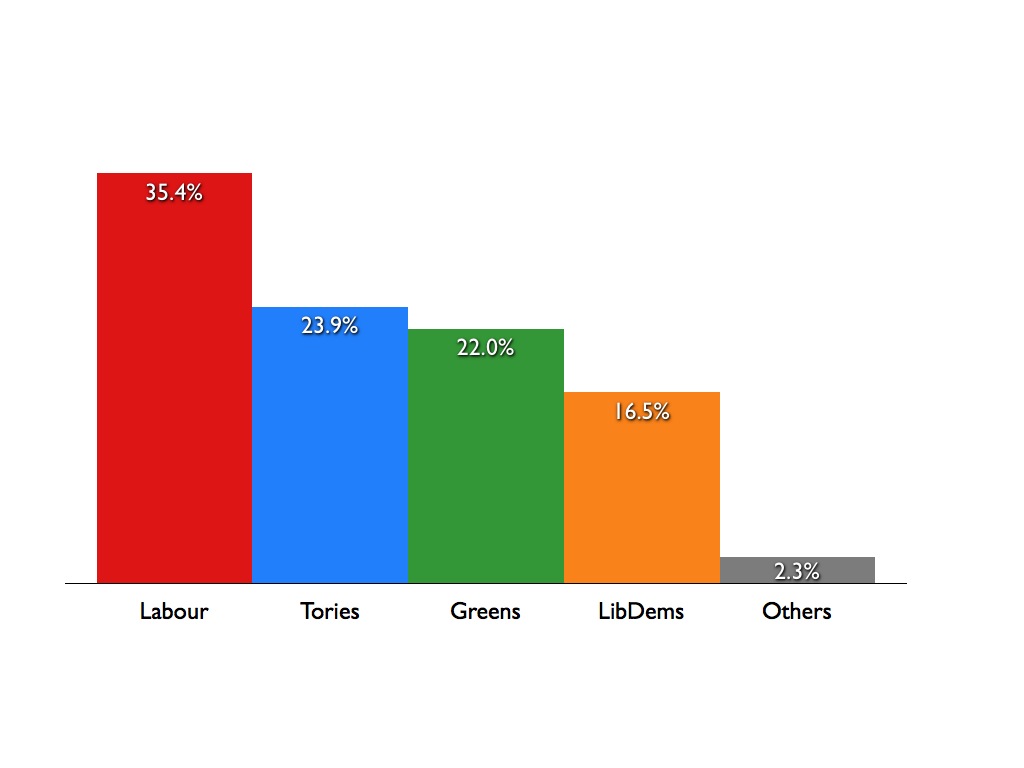
So let’s look at the tale of Brighton & Hove Green Party’s support in the Brighton Pavilion constituency. In 2005, when all the parties had different leaders (Blair, Howard, Kennedy and Greens yet to elect their first leader) and Brighton Pavilion had a different boundary, Keith Taylor brought home a record 22% of the vote for the Greens.

2005 General Election result, Brighton Pavilion

The May 2007 council elections saw us just beat the Tories into first place across the constituency. The December 2007 by-election in Regency ward (which elected me to the council) saw the gap between Greens and other parties widen dramatically. This was repeated in the 2009 Goldsmid by-election, but as it falls outside of Brighton Pavilion is not included here.

May 2007 Council Election results, Brighton Pavilion
December 2007, Regency council by-election result

Next we saw the June 2009 European Elections. Unfortunately we don’t have constituency-level results for these but city-wide Greens came top, beating all the parties for the first time, a feat we repeated in several other cities across the country.

June 2009 European Elections, Brighton & Hove city-wide result

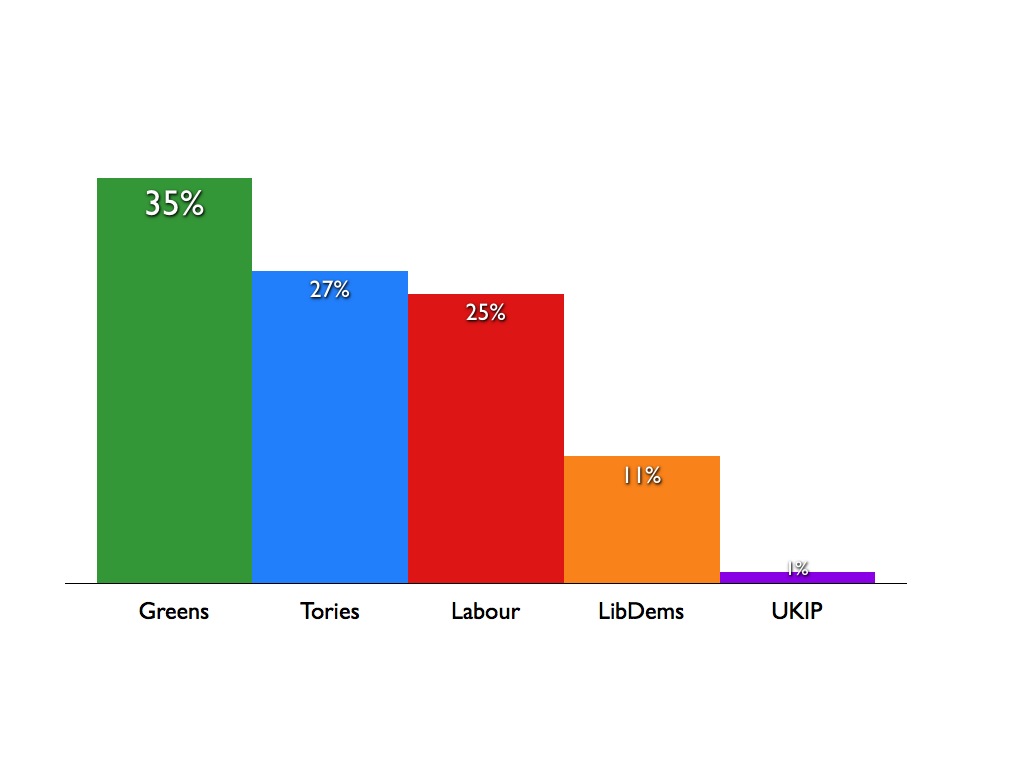
Finally in December 2009 the Green Party commission an ICM poll which showed the same pattern once again – Greens in the lead followed by Tories then Labour.

December 2009 ICM Poll Result, Brighton Pavilion

Some have criticised the poll result – yes it was commissioned by the Green Party – but ICM are a member of the British Polling Council and so are bound by its standards. It’s not like they bucked the trend – the graphs above show results have been pointing in this direction for quite some time. Furthermore the new boundary for Brighton Pavilion includes all of Hanover & Elm Grove ward, which is represented by three Green councillors and has had a strong Green vote for a very long time indeed.

All this to say that the electoral statistics are not easy to address for Caroline Lucas‘ opponents. Still it’s interesting to observe how they handle the challenge. Labour’s Nancy Platts goes for ignoring 5 years of history and suggesting that a Green vote will let the Tories in.

Graph of 2005 General Election result in a 2010 Labour leaflet from Nancy Platts
2005 Election Results, from Nancy Platts' website

This is Nancy’s only option, the most recent graph which shows Labour ahead in the constituency. Sadly, if anything, thanks to our electoral system a Labour vote is likely to let the Tories in this time around. Labour have been trying the old ‘Green vote lets the Tories in’ trick for years in Brighton & Hove, I think people are pretty sick of being told something which evidently hasn’t been held out in recent elections.

(On a side note in writing this post I’ve noticed that different online sources cite the 2005 Green result as either 21.9% or 22.0% — it’s not just a rounding issue, the actual voter numbers differ e.g. BBC vs UK Polling Report. Not a massive difference but just wanted to flag up that I’m aware of it.)

Charlotte Vere treads a rather unusual path with her graphs. First this gem from her most recent leaflet:

2005 General Election result, from 2010 Charlotte Vere leaflet

My scanner may not be the best in the world, but the graph really is that jagged and blocky on the leaflet itself! Notice anything missing from the graph? Yes – Green and LibDem votes! In my view, it really is an extraordinarily misleading graph.

The same leaflet also includes a graph showing remarkable levels of support for the Conservatives:

Pulse GP poll, from 2010 Charlotte Vere leaflet

Pulse, a news rag for GPs, conducted a poll of some of their readers. I’m told by GP friends that the paper is heavily funded by pharmaceutical companies and isn’t considered much of a serious news-source. Regardless, given that most GPs are well into the top tax bracket it’s no surprise they support Tories. But unless there has been a rush of GPs moving to live into Brighton Pavilion, this poll is unrepresentative and bears no relation to what’s happening in the constituency. Is it there for any reason other than to mislead?

While we continue to suffer under our simplistic, winner-takes-all electoral system I’m afraid these kinds of graphing horrors are likely to continue. Whoever people finally cast their vote for, I hope they do so informed by facts and not the graphing skills of the local Labour or Tory activists.

UPDATE: Of course all this talk backed by GP polls from the Tories about being the party of the NHS is deeply misleading as they’re planning to break it up into further private ‘marketisation’ so when they say ‘NHS’ they mean something completely different to what most people understand – more info

Categories
notes from JK

Speech: Responding to GP-led clinic scrutiny report

I presented this speech in response to a scrutiny panel report I contributed to being presented to full council 28th January 2010. Nobody answered my question at the end of the speech:

I would like to thank Cllr Denise Cobb who was chair of HOSC at the time for agreeing to create this panel after several months of questions on these matters by myself and other members.

I also thank the panel Chair Cllr Alford for his very even handed and co-operative working, as well as Cllr Allen, with whom it always a pleasure to serve with. My thanks to our officer Giles Rossington for his excellent support. I do commend this report to members.

This report is very timely given the continued pressure to further privatise parts of the NHS and package public services off to private businesses.

The panel’s concerns over the tender process favouring larger corporations should trigger alarm bells for all those worried about the future of the NHS. Similarly how such changes are consulted upon with the public was cause for concern with the panel and continue to be a public issue of importance.

These private contracts are riven with problems. The President of the British Orthopaedic Association recently wrote to The Times highlighting grave concerns over their quality control and service levels. A study of one private treatment centre found two third of operations showed poor technique and that after 3 years 18% needed revision operations compared to a 0.9% NHS-wide rate.

Cataract operations at a private treatment centre in Oxfordshire have cost up to 600% over the odds and performed only 93 of 572 contracted procedures for half a year. Meanwhile eye operations in a private contract treatment centre in Portsmouth have cost seven times more than they would on the NHS.

Health service experts the King’s Fund argue these contracts are a drain on Primary Care Trust finances. At a 2008 HOSC meeting a clinician from Brighton & Sussex University Hospitals Trust admitted that the private orthopaedic procedures alone were costing them £2-3 million a year.

The chosen contractor for Brighton’s clinic, Care UK, do have serious ongoing questions over their ability to provide consistent high quality care in our area as well as the rest of the country. In spite… or perhaps because of this… their annual healthcare profit has been in double digit growth for years, including 44% growth in profit for 2009.

Clearly the Conservative Party want more of this kind of privatisation when their 2010 health manifesto states that they aim:

“To give patients even more choice, we will open up the NHS to include new independent and voluntary sector providers…”

We recently learnt that the chairman of Care UK and his wife are giving tens of thousands to fund the Conservative shadow health secretary Andrew Lansley’s office.

So, the question I must ask the Conservative group is…. Is this the kind of privatising corporate ‘greed is good’ politics we can expect if David Cameron wins the general election?

Categories
notes from JK

Speech: A High Pay Commission

I copy below the speech I presented in support of this motion for a High Pay Commission, which was carried but only with a Labour wrecking motion (supported by the Conservatives) at full council 28th January 2010:

The top allowance for a councillor in this chamber is only 3.4 times more than the lowest councillor allowance. In terms of allowances, we are a fairly equally rewarded bunch, unlike much of society.

According to Compass, the average ratio of chief-executive to employee pay is 128 times, and several sources agree this has at least doubled in the last decade. In some FTSE 100 firms the pay ratio is now over 1,000 times.

Why limit high pay? Because it’s unfair, it doesn’t create better results and the gap between top and bottom pay is getting worse.

This motion really calls for what is fair pay for all. Shareholders and boards of directors have dramatically failed to reign in the widening pay gap. On pay, both private companies and public services have had long enough to get their house in order.

Some have dealt with the pay gap: A fixed ratio of top and bottom rates of pay is used by successful firms including Toyota, Whole Earth Foods and the St Lukes advertising agency. They do this because there is a good business case for limiting the ratio between top and bottom levels of pay.

Think of companies who have let our country down recently… the banks for example.

20 years ago the pay difference between a bank Chief Exec and next level down was only 2-3 times. Now the ratio between chief and deputy is 20-30 times, imagine what it is between Chief Exec and the lowest paid bank employee. Can we say we’re happy with how banks have conducted themselves? They’re now a national disgrace.

Such pay gaps lead to greater unfairness in our society. We know unfair differences in family income are a key factor that contributes to many societal problems.

The idea of a High Pay Commission to limit top pay is backed by the best business research. For example, Jim Collins for his bestselling book “Good to Great” conducted 112 analyses on pay ratios alone. He found that:

“…the idea that the structure of executive compensation is a key driver in corporate performance is simply not supported by the data.”

And he added:

“The right people will do the right things… regardless of the incentive system.”

Andy Law, from the St Lukes ad agency says:

“When you are exhorting people to co-operate with each other and to trust each other [at work], to impose an unequal system (as is most commonly done) is completely contradictory.”

If I haven’t convinced you so far, let’s try an example. Let’s think about this in a setting we can all relate to: the family. We were all children once…. In your family, how would you have felt if a brother, sister or cousin was awarded 128 more sweets than yourself for winning a game or doing a task particularly well?

You would be outraged with the unfairness and would feel dejected.

Such a huge gap in reward would not be motivating. Other than the one person gaining the disproportionately large reward, the rest would carry on demotivated. It isn’t fair.

Fairer pay is the hallmark of effective organisations, it’s good for business and good for society. The High Pay Commission we propose would be a step toward a more just, fair and balanced society – one in which all our families receive their fair reward for their hard work. Please support this motion.

Online Sources:

http://www.guardian.co.uk/business/2009/sep/16/guardian-executive-pay-survey-ratios

http://www.ft.com/cms/s/0/95d22e10-db89-11de-9424-00144feabdc0.html

http://www.nowandnext.com/?action=sector/view&issueId=25&sectorId=12

Categories
notes from JK

Organic flour has more minerals

Continuing tonight’s health theme, I wanted to post about some interesting data I’ve come upon. I followed up some letters published in the Soil Association’s Living Earth magazine.

The letters continued the debate over the FSA’s controversial report claiming no significant health benefits from eating organic. I’m not a food scientist but the terms and methods of the FSA report seemed destined for a narrow result which could be easily misinterpreted by the media. Though the pretty categorical wording of the FSA’s release helped the media along:

“there are no important differences in the nutrition content, or any additional health benefits, of organic food when compared with conventionally produced food”

What’s odd is that we’ve known for a long time that the mineral content in conventionally farmed produce has been declining. We also know that minerals are vital for maintaining our health. For example this 1997 paper shows how only Phosphorous has escaped significant decline over the fifty years between 1930s and 1980s whilst water content in fruit has increased significantly.

With financial support from some Soil Association members Peter Symonds, a chemist, analysed a variety of flours for their mineral content. Wholemeal, organic UK-grown flours were found to have by far the highest mineral levels for Selenium and Zinc. I’ve copied below the full data and comments from the chemist.

How we grow our food is important not just for the environment around us (e.g. fertilisers polluting our rivers) but for our longterm health. Mineral deficiencies can have long term debilitating health consequences. Sadly the government agency supposed to be championing healthy food is not just ignoring this issue but actively creating the impression the problem isn’t there!

[Full Data]

SELENIUM AND ZINC IN ORGANIC AND CONVENTIONALLY GROWN FLOUR.
January 2010

Hans Lobstein of Brighton and Ian Bowyer of Chelwood Gate, East Sussex,  members of the Soil Association,  have funded an initial consumer survey of white and wholemeal flour for bread making which is sold in England. The  brands Stoneground organic and Marriages organic which were grown in the UK have the highest amount of selenium than conventionally grown.

BRAND AND TYPE                     ORGANIC                   SELENIUM                 ZINC

ug/100 grams        mg/100 grams

Marriages       strong  white               yes                         20.0                         —

Stoneground   strong  wholemeal       yes                         18.0                         —

Marriages       strong  wholemeal        yes                        17.6                         3.4

Marriges         strong  white                no                         15.6                         3.3

Allinsons         strong  wholemeal        no                         11.6                         2.8

Carr                strong  wholemeal        no                         10.2                         —

Dove               strong  wholemeal        yes                         4.2                          —

Hovis               strong  white               no                           3.6                          —

Hovis               strong  wholemeal        no                           3.2                          —

Tesco              soft      white                no                           2.2                         0.8

Morrisons        soft      wholemeal         no                           2.0                         2.6

Dove               soft      wholemeal        yes                          1.0                         2.7

Carr                strong  white                no                           1.0                          —

I have a sneaking suspicion that supermarket own brand Organic will be found to be like the Dove organic rather than the Marriages and Stoneground organic.  The Marriages wholemeal is £ 1.35 per 1.5 kilogram while the supermarket own brand is about £ 1.  I fear that people who think they can get organic at lower price in the supermarket are being short changed overall.

Peter Symonds  B.Sc. C.CHEM. M.R.S.C.

pmsymonds@yahoo.co.uk

http://sites.google.com/site/apexanalytical

[Earlier notes accompanying initial results]

1st December 2009

FOOD STANDARDS AGENCY REPORT COMPARING ORGANIC AND CONVENTIONALLY GROWN FOOD.

The Food Standards Agency has published a report that reviewed some published literature. The report concluded that organic food was not more nutritious than conventionally grown.  Hans Lobstein, a member of the Soil Association,  has funded an initial survey of wholemeal and white flour for breadmaking sold in England. The  brands Stoneground organic and Marriages organic which were grown in the UK have and higher amounts selenium and zinc than conventionally grown, see table.  The Dove flour is derived from wheat grown in Kazakhstan.

The full consumer survey would involve testing other premium brands such as Hovis and McDougal and supermarket own brand Organic flour.

The survey could be further extended to testing for all trace elements.  These can be measured reasonably cheaply using a modern analytical instrument, X Ray Fluorescence,  which measures all trace elements in one go.

A final effort would involve choosing 10 conventional farms and 10 organic farms (matched for wheat variety, soil and climate) and testing the wheat for selenium and trace elements.

300 grams of Stoneground flour per day provides about 56 ug of Selenium while other foods provide about 30 ug per day. Brazil nuts have approx 1560 ug per 100 grams so a few grams of nuts would bring the daily intake to the lower end of the recommended, 100 to 200 ug per day,  all without taking a supplement.  The figure for Brazil nuts has not been found from analysing nuts in health food shops but taken from The Composition of Food by McCance and Widdowson.  Of course,  Brazil is a big place and the composition of nuts may vary across the country.

Peter Symonds     pmsymonds@yahoo.co.uk

http://sites.google.com/site/apexanalytical

Categories
notes from JK

The Element – On education and creativity, plus my books of 2009

Academic inflation continues ever apace, it is now the case that a PhD isn’t enough for some posts. My father worked over 30 years for a bank. He entered with nothing more than A-levels. Since then the job, which has little changed in substance, now requires one or more degrees, probably an MBA would help too.

Meanwhile the British government continues its process of expanding the length of compulsory education. It is bringing forward the school starting age from 5 to 4 years young. Furthermore it is extending the education and training age to 18, up from 16 years. So in total they are potentially adding 3 years to the length of compulsory education.

For all those children who hated school, felt constrained and misunderstood, this is a disaster. We already start school earlier than most European countries, and don’t have better results to show for this early start. As Sir Ken Robinson has so ably shown – there is a huge list of very successful people who only blossomed after school’s negative effects had had a chance to wear off.

Truancy is at record levels too — no wonder what with more testing, a more restrictive curriculum, and the failure to nurture diverse types of intelligence. We are killing creativity and extinguishing passions with an incessant focus just on ‘academic’ education; that is maths, literacy, and sciences.

You can’t learn many of the most valuable things in life simply by being told them and then reciting them for a test. Education should be a much richer experience. We have absolutely no idea what life will bring for our children. We cannot possibly imagine what the world will be like by the time they leave education, especially considering the current failures to tackle climate change.

I was extremely fortunate to recently visit what I think is an excellent example of following your passion, caring for the environment and the unexpected connections education can bring. During a North American family reunion I visited Tom’s of Maine in Kennebunk, Maine, USA. Tom’s produce natural personal care products such as toothpaste, dental floss and soap. The company works towards an ethical mission which includes donating a proportion of revenue to charities and treating their employees with care and respect.

When visiting their factory I was impressed with the breaks staff took for exercises, the way disabled staff were supported in being productive team-members and the care taken in reducing the environmental impact of their operations. While there I also picked up the two books written by Tom Chappell, which I found to be fascinating, inspiring reads.

In particular the books tell of how Tom (who co-founded the firm with his wife Kate) started to lose his passion for the business as the focus became ever more on ‘making the numbers’. Rather than quitting by selling the business, Tom decided to take up a part-time theology course at Harvard. This rather unexpected change in direction for a former insurance salesman led to a renewal in his passion for his business. He engaged on an ethical, environmental and creative level resulting in a wide set of changes in how they did business and a massive increase in the number of new product ideas. Creativity was unleashed.

How many people would have advised Tom to go on a part-time theology course to resolve his business problems or loss of passion? Not many I would imagine. He writes that many of his colleagues had their doubts, and I’m not surprised. But by connecting with an alternative way of thinking and different people a new passion was found. I think we’re all better off for the work Tom’s has been doing since then. It’s not to say we’ll all renew our passion by going on a theology course, but to say that creativity and passion are not science, they lie in unexpected connections.

I’ve been searching for my passion, slowly homing in on what it means for me to be in my element. Through school I focussed on good grades and subjects that would have the most use for employment. To some extent I regret that now.

Some of the choices I had to make were ludicrous. For example for my A-levels I wanted to do Physics, English Language and Biology. I was told only English Literature was available and I couldn’t do it anyway as it wasn’t possible to combine it with science subjects. So at 16 I had to choose between science or ‘arts’ not just for A-levels but for my university career also. I ended up doing Maths, Physics and Chemistry with A/S French for Professional Use. I had hated maths since age 10 and didn’t feel strongly about chemistry one way or the other. Physics I did enjoy, but partly because I had yet to reach the maths-intensive levels.

How utterly mad to force a 16-year old to make such choices. It’s difficult enough in one’s thirties making career choices, let alone when one is still very much a personality in development. I know my old school has now gone for the International Baccalaureate to try and broaden pre-university education.

IB is probably an improvement but lacks the opportunity for subjects such as dance, music or sculpture to fully integrate into schooling so that pupils of all abilities and passions can be catered for. We need to completely turn our educational system upside down. Helping people to find and nurture their passion is quite possibly the most important thing we can do for one another as a society.

Reads of 2009

I’ve read many excellent books this year, in fact barely any have been duds. Ones that spring to mind include Tristram Stuart’s “Waste” and Prashant Vaze’s “The Economical Environmentalist”.

Only two books this year have fundamentally altered my way of thinking, challenged me in the most positive ways, and been deeply impressive.

These were Sir Ken Robinson’s “The Element” and Tom Chappell’s “The Soul of a Business”. If you read just two books in 2010, make it those. To expand and support them two other books are worth a look, Sir Ken’s “Out of our Minds” and Tom’s “Managing Upside Down”. They aren’t quite as good or punchy as the first two, but they usefully expand the ideas and context.

More Resources:

I first came across Sir Ken through his incredible, must see, TED talk (via Garr Reynold’s great blog Presentation Zen)

If you are looking for your passion, Po Bronson’s “What Should I Do with My Life?” is another useful, non-prescriptive, book.

Note: All Amazon links for books will pay a commission to me if you purchase the book.